How to Measure Quality in Apparel Manufacturing: Key Metrics and Inspection Methods
Learn how to measure quality in apparel manufacturing: DHU, defect rate, RFT, AQL pass rate, and the inspection methods that produce reliable numbers.

Triple Tree Solutions
Published
November 17, 2026
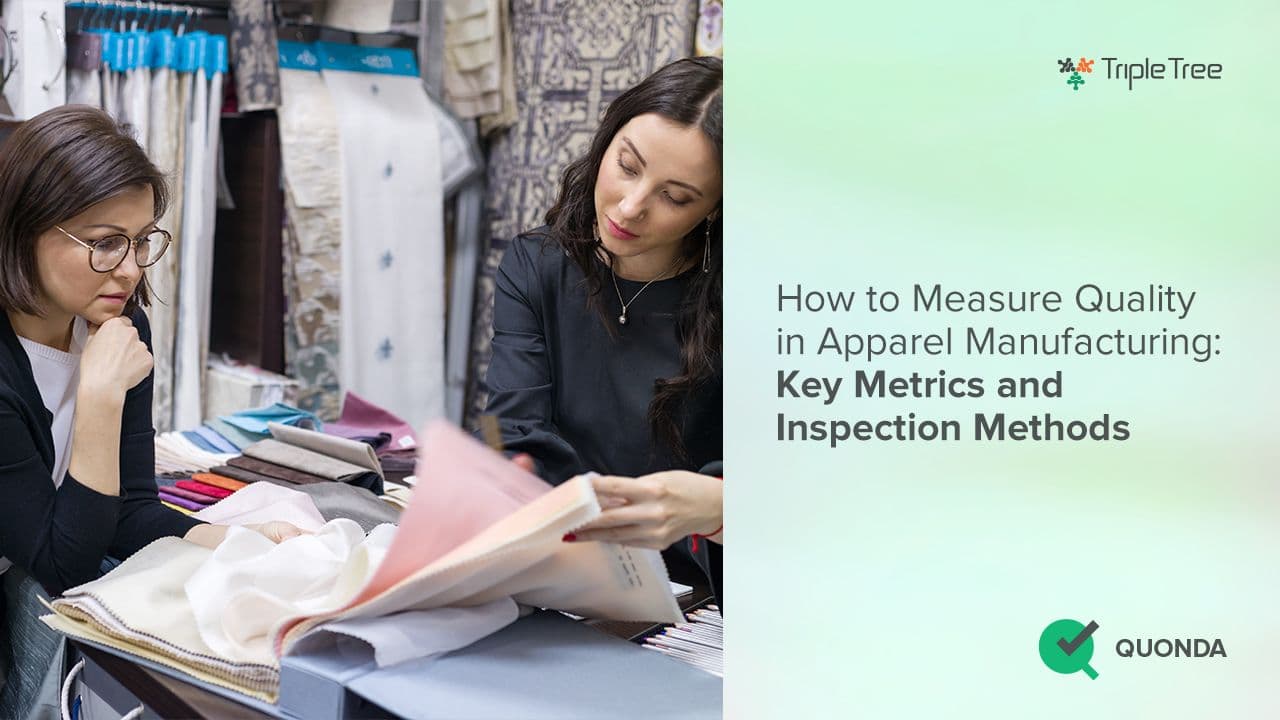
A shipment can pass final inspection and still come back as a chargeback. When that happens, the factory or inspector was usually counting inspections, not measuring quality.
Most advice on how to measure quality in manufacturing is written for machined parts and assembly lines. Apparel is different. Fabric stretches, shade shifts between dye lots, and one style can run in five factories across three countries. The numbers have to hold up in all of them.
This guide covers the quality metrics apparel teams rely on, the formula behind each one, and the inspection methods that generate the data. It is for quality managers, sourcing teams and factory leads who need figures they can compare across lines, vendors and seasons.
What It Means to Measure Quality in Apparel Manufacturing
Measuring quality means turning inspection findings into numbers you can compare by style, line, factory and season.
If you are asking what is quality control in manufacturing, it is the set of checks that confirm a product meets its specification before it moves to the next stage or ships. Measurement is what makes those checks useful. Without it, you know a lot failed. With it, you know which operation, which defect type and which vendor caused the failure.
A garment is measured against three things:
- Specification. Each point of measure (chest, sleeve length, inseam) is checked against the size chart and its tolerance.
- Workmanship. Stitching, seams, trims, labels and finishing are checked for defects.
- Material and performance. Fabric is checked for faults, shade, weight, shrinkage and colorfastness.
Every defect is then graded by severity, because one broken needle fragment matters more than ten loose threads:
- Critical: a safety or regulatory failure, such as a sharp object in the garment or a wrong fibre content label.
- Major: a fault likely to cause a return, such as an open seam, a wrong size label or visible shade variation between panels.
- Minor: a fault unlikely to affect the sale, such as an untrimmed thread end.
Looking for a Complete Quality Guide Instead?
Read hereWhy Measuring Quality Protects Margin
A defect gets more expensive at every stage it survives. That is the practical answer to why is quality control important in apparel, and it is why the timing of measurement matters as much as the measurement itself. For instance, a defect caught in-line is much cheaper to fix than one caught in the final stages.
Take a single open seam:
- At the needle: the operator restitches it in seconds.
- At end-line: the garment goes to rework and the line loses output.
- At final inspection: the lot fails, gets sorted and reinspected, and the ship date moves.
- At the distribution centre: the brand issues a chargeback, pays for air freight on replacements, or marks the goods down.
Consistent numbers also change the commercial conversation. A sourcing team with twelve months of first-time pass rates per vendor can allocate orders on evidence, not on the last shipment anyone remembers.
Key Quality Metrics for Apparel Production
Eight metrics cover most of what an apparel quality team needs, from fabric receipt to customer returns.
| Metric | Formula | What it tells you |
|---|---|---|
| DHU (defects per hundred units) | (Total defects found ÷ garments inspected) × 100 | Workmanship level on a line. Counts every defect, even several on one garment. |
| Defect rate (percent defective) | (Defective garments ÷ garments inspected) × 100 | The share of garments with at least one defect. |
| Right first time (RFT) | (Garments passed at first check ÷ garments checked) × 100 | How much output needs no rework. |
| First-time inspection pass rate | (Final inspections passed at first attempt ÷ final inspections held) × 100 | Vendor reliability at shipment stage. |
| Measurement compliance | (Points of measure within tolerance ÷ points measured) × 100 | Fit and spec accuracy by style and size. |
| Fabric points per 100 square yards | (Total penalty points × 3,600) ÷ (yards inspected × fabric width in inches) | Fabric quality before it is cut. |
| Return or claim rate | (Units returned or claimed for quality ÷ units shipped) × 100 | What the customer experienced. |
DHU and defect rate measure different things
Say an end-line checker inspects 500 garments and finds 40 defects spread across 28 garments.
- DHU = (40 ÷ 500) × 100 = 8
- Defect rate = (28 ÷ 500) × 100 = 5.6%
- RFT = (472 ÷ 500) × 100 = 94.4%
DHU is higher because some garments carry more than one defect. Use DHU to manage the sewing line and defect rate to judge how many pieces are unfit to ship. Reporting only one hides half the picture.
Leading and lagging quality metrics
DHU, RFT and measurement compliance are leading metrics. They move while the order is still on the line, when a fix costs minutes. First-time inspection pass rate and return rate are lagging metrics. They confirm the result after the cost is already locked in.
A factory that only tracks pass or fail at final inspection is measuring quality too late to change it.
Learn more about how real-time data provides astromical value
Read NowInspection Methods That Produce the Data
Each metric comes from a specific inspection stage. Skip a stage and the metric it feeds goes dark.
| Inspection Stage | When it happens | What is checked | Metrics it feeds |
|---|---|---|---|
| Fabric and trims inspection | On receipt, before cutting | Fabric faults, shade, width, weight, trim accuracy | Fabric points per 100 square yards |
| Pre-production inspection | Before bulk cutting starts | Approved sample, patterns, trims, size set results | Measurement compliance on samples |
| Inline inspection | From first output through mid-production | Workmanship at each operation, measurements on partly made garments | DHU, RFT |
| End-line inspection | As each finished garment leaves the line | Full check of every piece | DHU, defect rate, rework rate |
| Final random inspection | Order fully produced and at least 80% packed | A statistical sample checked for workmanship, measurements, labelling and packing | First-time inspection pass rate |
| Lab testing | Before bulk approval and on bulk fabric | Shrinkage, colorfastness, pilling, seam strength | Test pass rate |
How AQL sampling works in a final inspection
Final random inspections use acceptance sampling under ISO 2859-1 (ANSI/ASQ Z1.4 in the US). The standard sets how many pieces to pull from a lot and how many defects that sample can contain before the lot fails.
Most apparel buyers inspect at General Level II with an AQL of 2.5 for major defects, 4.0 for minor defects and zero tolerance for critical defects. For an order of 5,000 pieces, that means:
- Sample size: 200 pieces
- Major defects: accept at 10, reject at 11
- Minor defects: accept at 14, reject at 15
- Critical defects: reject at 1
AQL is a statistical limit, not a promise of zero defects. A passed lot can still contain faulty pieces, which is why inline and end-line data matter more for prevention.
The 4-point system for fabric inspection
Fabric is graded by assigning penalty points to each fault by its length: 1 point up to 3 inches, 2 points from 3 to 6 inches, 3 points from 6 to 9 inches and 4 points over 9 inches. No single linear yard can score more than 4 points.
Many buyers accept rolls at up to 40 points per 100 square yards, though the limit varies by buyer and fabric type. Rolls above the limit are rejected or downgraded before they reach the cutting table.
How to Turn Inspection Data Into Better Quality
Metrics only pay off when they change what happens on the line. For teams working out how to improve quality control in production, these six steps turn inspection data into fewer defects.
- Standardise defect definitions. Use one defect library, with photos and severity levels, across every factory. If two inspectors classify the same fault differently, the numbers cannot be compared.
- Capture data at the point of inspection. Paper reports typed up later arrive after the lot has moved on. Digital capture on the floor makes the result usable the same day.
- Rank defects by frequency. A handful of defect types typically drive most of the DHU. Fix those first.
- Trace each top defect to its source. Tie it to an operation, machine or operator, then address the cause: needle type, machine setting, pattern, handling or training.
- Set thresholds that trigger action. Decide in advance what DHU or measurement failure level stops a line or escalates to a supervisor.
- Score vendors on the same card. Review first-time pass rate, DHU and rework by vendor every month, and use the trend in order allocation.
Measure Quality Across Every Vendor With QUONDA
QUONDA is Triple Tree's digital quality management platform for garments and textiles. It replaces paper and spreadsheet inspection reports with data captured on the factory floor, so the metrics in this guide are calculated the same way at every vendor.
- Inspection scheduling: plan inspections and monitor their status in real time.
- Customized inspection workflows: set checkpoints, defect lists and measurement steps to match each buyer's standard.
- Custom inspection reports: generate reports in the format your teams and customers need, without retyping.
- Supplier risk and rating insights: see which vendors are improving and which need intervention.
QUONDA is trusted by 200+ apparel manufacturers across 12 countries. See how it supports garment quality control from inline checks to final inspection.
Frequently Asked Questions
What is a good DHU in garment manufacturing?
There is no universal benchmark. DHU depends on product complexity and on how strictly a factory defines a defect. Set a baseline by line and style, then target a steady reduction from it.
Which AQL level do apparel brands use?
The most common setting is AQL 2.5 for major defects and 4.0 for minor defects, with no critical defects allowed. Premium and childrenswear buyers often tighten major defects to 1.5.
What is the difference between inline and final inspection?
Inline inspection checks garments while they are being sewn, so faults are fixed before they repeat. Final inspection checks a sample of the packed order and decides whether it can ship.
How often should quality metrics be reviewed?
Review DHU hourly on the line, RFT and rework daily at factory level, and first-time inspection pass rate monthly by vendor.
Start Measuring Quality the Same Way Everywhere
Comparable numbers are what turn inspection from a gate into a tool for improvement.
Fresh insights for a stronger supply chain
Get practical guides and industry insights on apparel quality, color management, and production tracking. Straight to your inbox.
TRENDING NOW
Community Favorites
INSIGHTS
How to Reduce Downtime in Manufacturing: Causes and Strategies for Apparel Production

Triple Tree Solutions
Nov 11, 2026
INSIGHTS
Supplier Quality Management for Apparel: Audit Guide
Triple Tree Solutions
Oct 27, 2026
VENDOR MANAGEMENT
The Complete Guide to Vendor Management in Apparel and Textile
Triple Tree Solutions
Oct 23, 2026
INSIGHTS
Apparel Supply Chain Management Software: 4 Best Solutions
Triple Tree Solutions
Oct 15, 2026