The Complete Guide to Textile & Apparel Quality Inspection
Apparel production quality depends on structured inspections throughout the manufacturing lifecycle. Brands have to manage each stage from raw material checks, to inline and final inspection to reduce defects, improve compliance, and deliver better products. This guide explains every stage of modern apparel quality control and how digital technologies like QUONDA is necessary to streamline inspections.
Triple Tree Solutions
Published
July 2, 2026

In the apparel and textile industry, ‘quality’ is not something checked at the end of the production but defined across every stage. From fabric sourcing to stitching and finishing, even a minor defect results in rejected shipments, costly rework, and revenue loss.
The financial impact is significant.
Online apparel returns in the United States cost more than $38 billion annually with incredibly high average return rate of 24.4%. It is not a single item that is returned, but the reverse logistics, checks, and restocking cost 65% of the original price.
It is why inspection is critical to physically check products, identify defects, and enable critical decisions in real time. However, in most factories the inspection activity still relies on manual processes and paper-based checklists. Combined with delayed reporting, it becomes difficult to detect issues early, respond quickly, and maintain consistent quality across production.
The challenge is more complex in global apparel supply chains as production is spread across multiple vendors, locations, and handoffs. As a result, apparel manufacturers have limited visibility and control over quality at various stages.
To address issues, brands are integrating digital quality inspection systems that provide real-time visibility, standardized workflows, and data-driven insights.
This guide explores how apparel quality inspection works, the different types and methods used, and common challenges in traditional approaches. Also, how digital solutions like QUONDA are transforming apparel inspection into a faster, more reliable, and scalable process.
What Is Textile and Apparel Quality Inspection?
It is a systematic process to check apparel products and ensure they meet the standards for performance, safety, and appearance throughout production.
Instead of guesswork, a trained inspection team thoroughly reviews four key aspects of a garment that includes
Workmanship: Check for defects like faulty zippers, broken buttons, lose threads, open seams, and uneven stitching.
Measurements: Using measuring tools to compare the garment dimensions with the brand’s tech pack.
Fabric and Color: Look for fabric flaws, stains, shade variation, color consistency, and printing defects among the batches.
Labeling: Ensure care labels, size labels, hangtags, barcodes, and packaging comply with brand, and regulatory requirements.
The Difference Between Quality Terms?
While often used interchangeably, Quality Assurance (QA), Quality Control (QC), and Quality Inspection (QI) have distinct roles in apparel supply chain management.
Let us view the difference between the three terms
| Aspect | QA | QC | QI |
|---|---|---|---|
| Purpose | Prevent defects | Detect and control defects | Examine products and record inspection results |
| Focus | Processes and standards | Production quality | Individual garments or batches |
| Timing | Before and during production | During production | At defined inspection stages |
| Outcome | Better manufacturing processes | Consistent product quality | Accept, reject, or rework products |
| Action Example | Writing the standard operating procedures (SOPs) for a factory floor. | Analyzing monthly defect trends across separate sewing lines. | Checking 80 shirts from a batch to approve or reject a shipment. |
Each stage is crucial in identifying issues early, reducing defects, and maintaining consistency across batches.
As production scales and supply chains become more intricate, the need for accurate, real-time inspection data becomes essential. It drives the adoption of digital tools that replace manual and fragmented processes.
Why Quality Inspection Matters
In a competitive fashion industry, quality is a defining factor that influences brand reputation, customer satisfaction, and long-term profitability. Apparel quality issues not only stall production but trigger a "Cost of Poor Quality" (CoPQ). The cost can account for 15–25% of sales due to rework, warranty claims, expedited shipping, and retail markdowns.
Beyond the balance sheet, maintaining textile quality standards helps navigate strict global compliance and rising consumer expectations. A significant shift in consumer behavior shows that almost 71% look for durability and ethical production. It means delivering sub-par garments will only lead to brand erosion and loss of market share.
Let us Breakdown the Real Cost of "Getting it Wrong"
| Impact Area | Consequence of Poor Quality |
|---|---|
| Brand Reputation | Customer complaints, negative reviews, reduced trust, and weaker retailer relationships. |
| Financial Performance | Rework, warranty claims, markdowns, excess inventory, and high return rates (averaging 20–30% for e-commerce) |
| Legal & Compliance | Potential recalls, heavy fines for non-compliance with safety standards (e.g., REACH in Europe or CPSIA in USA), and shipment seizures. |
In an era of fast fashion and viral social media reviews, consistent quality control is the only way to protect your reputation and ensure success.
The Key Objectives of Apparel Quality Inspection
To mitigate these risks, brands and manufacturers need to establish structured inspection protocols designed around these objectives.
Consistency: Ensure garment meets the quality standards across batches, styles, suppliers, and production runs.
Defect Prevention: Identify issues early and reduce defects to minimize rework and waste
Compliance: Verify that products meet regulatory requirements, safety standards, and brand specifications.
Cost Reduction: Reduce rework, waste, returns, and production delays.
Customer Satisfaction: Deliver products that meet expectations and strengthen brand loyalty.
The Three Stages of Apparel Quality Inspection
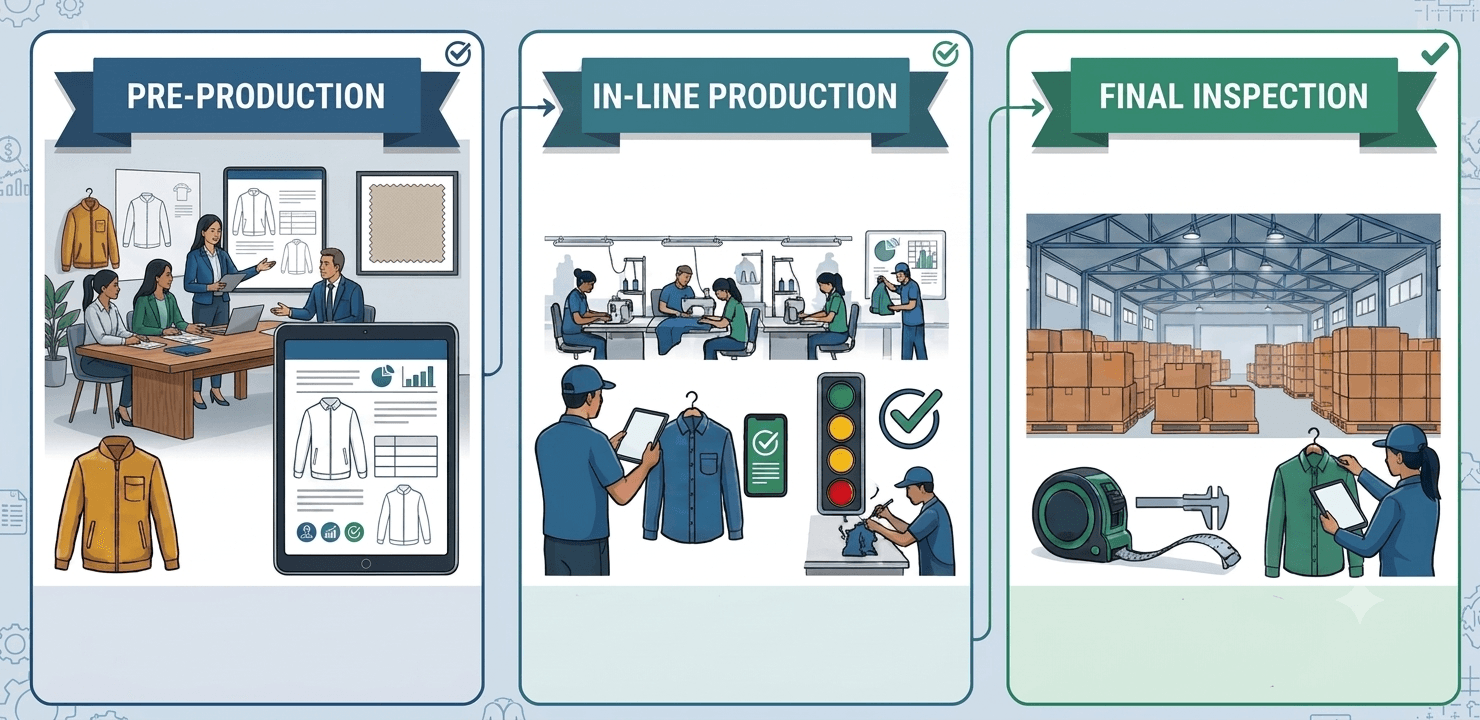
An effective quality inspection process is not a single activity but spans the entire apparel production lifecycle. It is divided into three stages ‘Before, During, and After‘. Each stage serves to reduce defects, minimize rework, and ensure the finished garments meet brand and customer requirements.
Let us explore each stage
1. Before Production
PPI (pre-production inspection) takes place before bulk manufacturing begins. The focus is verifying that all inputs such as raw materials, trims, and initial samples meet the required specifications.
At this stage, teams review:
- Fabric quality, color, and composition
- Trims and accessories
- Approved samples and technical specifications
The objective is to ensure that production starts on the right foundation and reduces costly downstream corrections.
Key Activities
Fabric Inspection: Reviewing raw material rolls for flaws (weaving holes, drops, stains) and ensuring strict color consistency across distinct dye lots.
Physical and Lab Performance Testing: Testing fabric swatches for shrinkage tolerances, colorfastness during washes, pilling resistance, and exact GSM (fabric weight) compliance.
Material Verification: Cross-referencing trims, zippers, buttons, and brand labels against the original tech pack blueprints.
Sample Approval: PP (pre-production) or TOP (top of production) samples are reviewed to align quality expectations before full-scale production.
2. During Production (DUPRO)
Inline inspection is performed when roughly 10% to 20% of the production run is complete. Quality teams move along the sewing lines to detect flaws and prevent a single error from duplicating across thousands of pieces.
Key focus areas include:
- Stitching quality and construction
- Measurement accuracy
- Workmanship and handling defects
By identifying issues in real time, immediate corrective actions can help prevent defective products from moving down the production line.
Key Activities
Cutting Check: Ensure fabric pieces are cut accurately according to patterns to avoid size inconsistencies.
Sewing Inspection: Verify seam strength, and stitches per inch (SPI) to eliminate defects like skipped or uneven stitches.
Mid-line Audits: Conduct frequent checks on partially assembled garments to prevent bulk production defects.
Measurement Checks: Confirm garment dimensions at different stages match specified measurements
3. After Production
Final inspection is conducted when 100% of the order is fully manufactured and at least 80% is packed into shipping cartons. It serves as the last checkpoint to verify that finished products meet quality standards and order requirements.
This typically involves:
- Random sampling based on AQL standards
- Visual inspection for defects
- Packaging checks
This stage is crucial for shipment approval, and issues identified at this time often result in delays, rework, or rejected orders.
Key Activities
AQL Sampling: Evaluate a sample of garments for defects, functionality, and overall appearance.
Garment Functionality: Test zippers, buttons, and stitching strength to ensure durability and usability.
Packaging and Labeling: Ensure correct tags, care instructions, and packaging standards are applied.
100% Inspection (Special Case): Sometimes in high-risk or premium orders, every single item is checked for defects.
While these stages are standard, the ‘speed‘ at which data moves between the textile and apparel quality control process determines the success. Transitioning from paper-based reports to quality control software like QUONDA allows these checkpoints to happen faster. The features such as instant defect photo sharing, AI inspector recommendation, and color code defect tagging ensure better consistency across factories and suppliers.
The Garment Inspection Methods
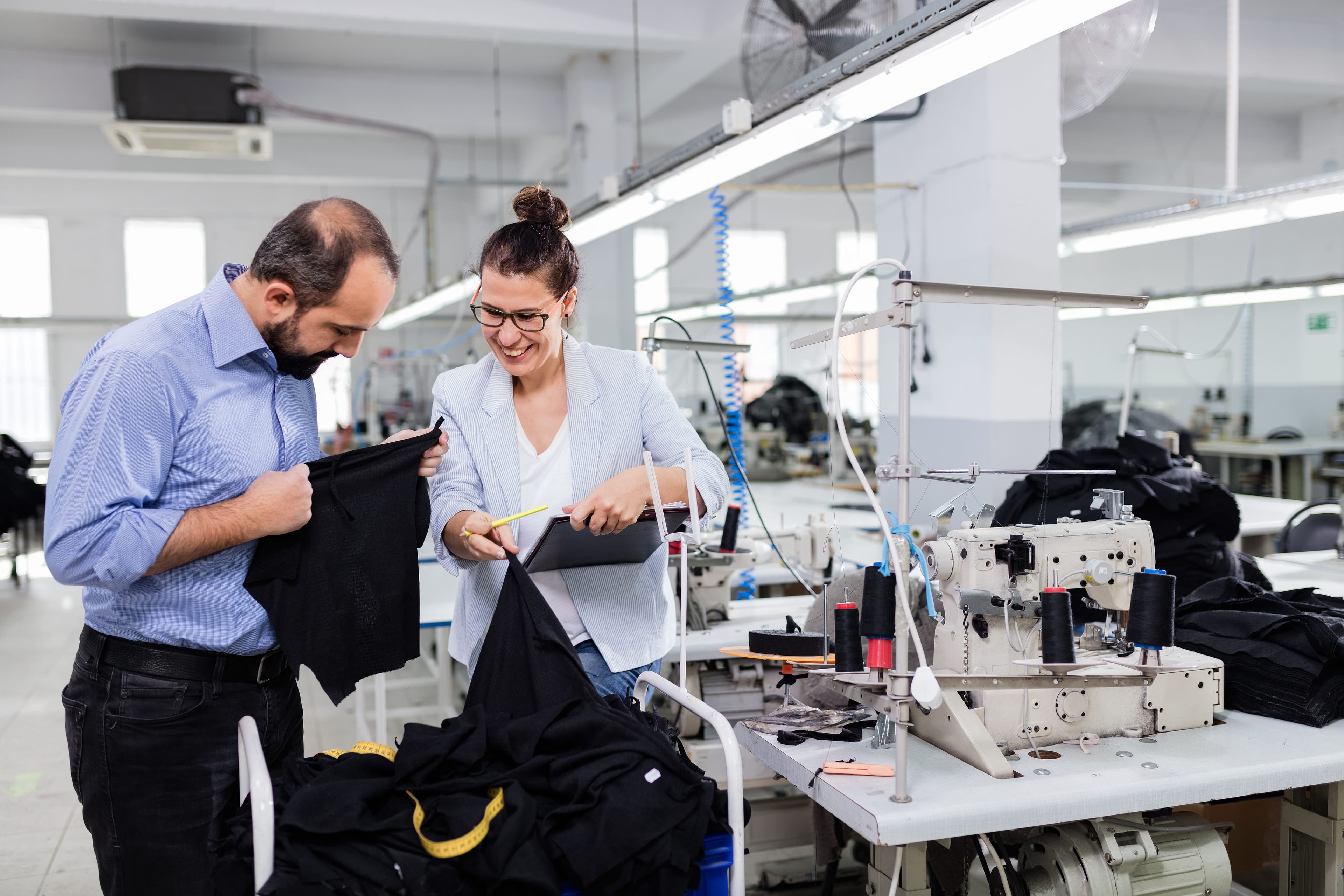
In addition to when inspections are conducted, it is equally important to understand how they are performed. Apparel inspection methods define the approach to evaluate product quality with
1. Visual Inspection
It is the most common method where inspectors examine garments to identify visible defects that affect appearance and overall quality.
This includes checking for:
- Fabric flaws (holes, stains, shading variations)
- Stitching defects (loose threads, skipped stitches)
- Finishing issues (poor pressing, uneven seams)
As a largely manual process, visual inspection depends heavily on inspector skill and consistency.
2. Measurement Inspection
It ensures that garments meet specified size and fit requirements. Inspectors compare product dimensions against approved size charts and tolerances.
Typical checks include:
- Garment length and width
- Sleeve and inseam measurements
- Neck, chest, and waist specifications
Accurate measurement is critical for maintaining fit consistency across batches, particularly in large-scale production.
3. Functional Testing
The process involves evaluation of how a garment performs under normal usage conditions. While not always conducted for every product, it is essential for ensuring durability, safety, and compliance.
Examples include:
- Color fastness and wash tests
- Fabric strength and durability
- Fastener performance (zippers, buttons, snaps)
In most factories, these inspections are carried out manually and recorded on paper, which often leads to inconsistencies and delayed reporting. Modern inspection systems streamline this process by real-time data capture, standardized defect classification, and instant reporting. Garment quality control through QUONDA improves both accuracy and decision-making across production.
The Importance of AQL Inspection Stage
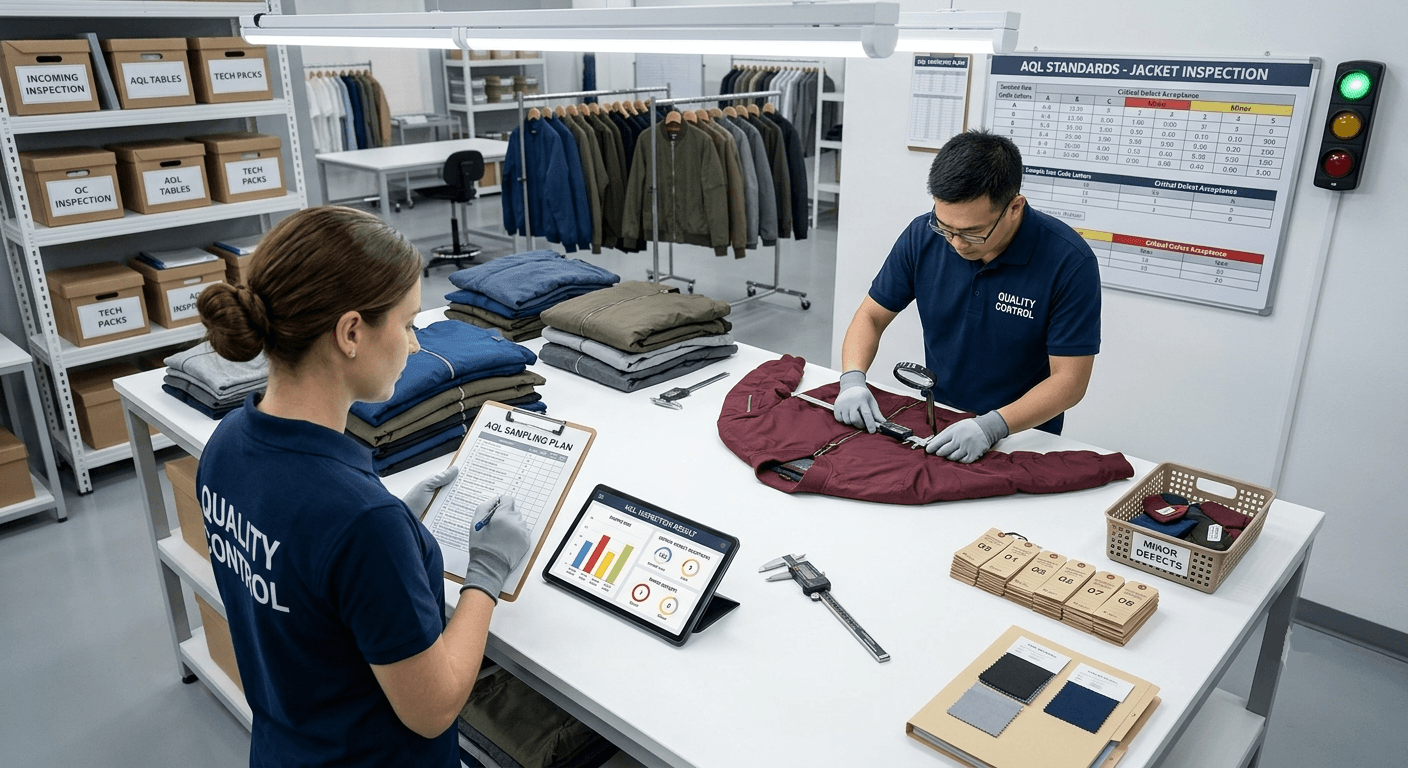
AQL (Acceptable Quality Limit) is an industry standard statistical sampling method. It is a mathematical measurement of the maximum number of defects that can be acceptable within a random sample size. AQL is primarily applied during final apparel inspections, where a random sample is selected from the finished batch.
An inspector pulls a specific number of garments from the total packed shipment based on an AQL Chart (typically ISO 2859-1). If the number of flaws exceeds a pre-determined "Rejection Point," the entire lot is failed and must be 100% re-screened by the factory.
AQL Levels and Acceptance Criteria
| Defect Type | Definition | AQL Level | Example |
|---|---|---|---|
| Critical | Hazardous, unsafe and violates regulations | (0.0) | A needle left in a seam or sharp edges |
| Major | Functional or significant aesthetic flaws | (2.5) | A broken zipper or a noticeable hole |
| Minor | Small imperfections that do not affect the garment's performance or overall appearance | (4.5) | Loose threads, misaligned labels |
Example:
For a production lot of 2,400 garments, an inspector may select 125 units for inspection under a 2.5 AQL standard.
- If the acceptable limit for major defects is 7, the batch will pass only if 7 or fewer defects are found in the sample.
- If 8 or more defects are identified, the lot fails inspection and may require rework or further review before approval.
Here are the Steps of AQL Inspection
1. Determine Sample Size
Select the number of units to inspect based on the total batch size and the chosen AQL level.
2. Categorize Defects
Classify defects as critical, major, or minor according to severity and impact.
3. Inspect Sample Units
Examine the selected units for defects using visual checks, measurements, and functional tests.
4. Compare with AQL Limits
Count the defects and compare them against the allowable limits for each defect category.
5. Decide Batch Acceptance
Accept the batch if defects are within limits; reject or request corrective actions if limits are exceeded.
Usually inspectors carry printouts of AQL charts, tally defects on paper, and calculate percentages manually that is vulnerable to errors. Digital solutions eliminate this entirely by embedding the complete ISO matrix directly into the mobile application. The software instantly calculates the exact sample size needed and automates the pass/fail verdict the moment a defect is logged.
The Common Garment Defects
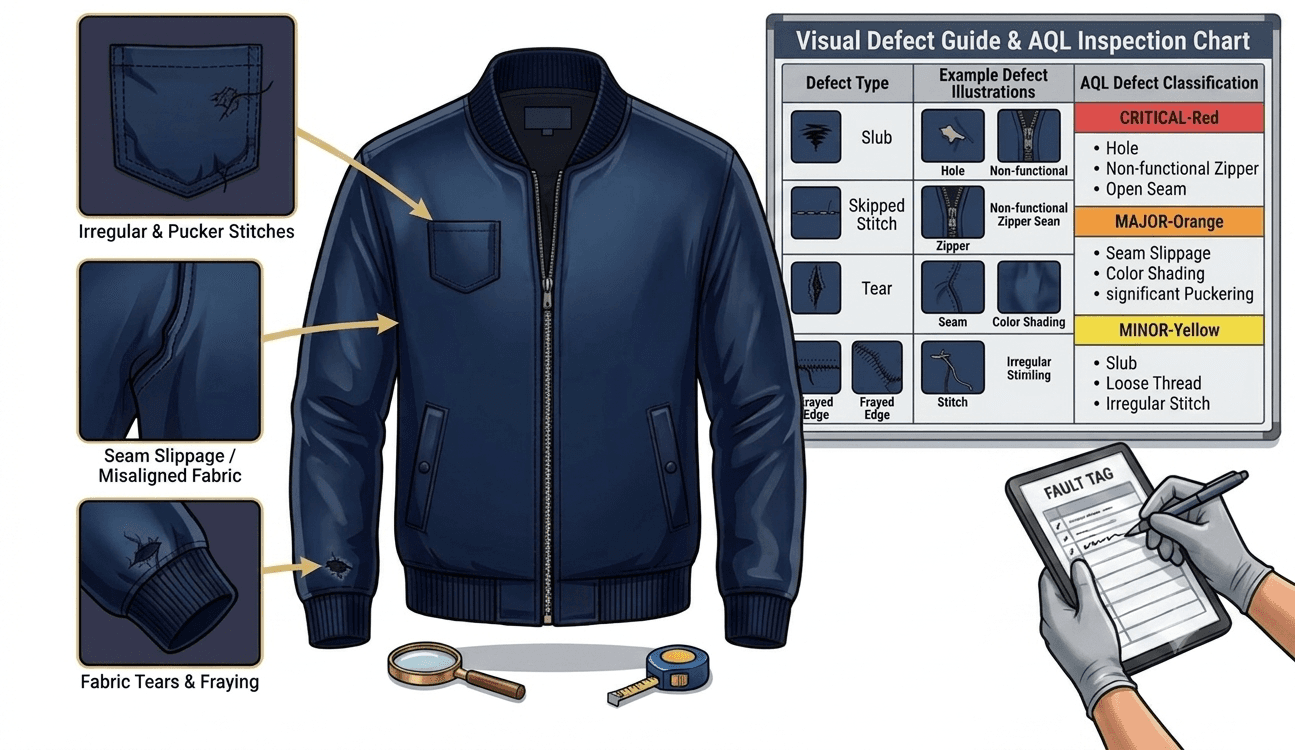
Identifying and addressing garment defects is critical to maintaining high-quality standards. A structured inspection process helps brands in managing quality in the apparel industry. Inspectors use standardized industry terminology to classify defects into distinct categories
Let us view them
1. Sewing and Workmanship Defects
These occur during garment assembly and are often due to sewing machine calibrations, improper needle choices, or worker error.
- Open Seams: Unstitched or partially stitched seams.
- Broken/Dropped Stitches: Gaps in stitching caused by broken needles or thread tension.
- Seam Puckering: Wavy or uneven appearance along the seam.
- Untrimmed Threads: Loose thread ends not cut during finishing.
- Wrong SPI (Stitches Per Inch): Stitch density does not match the brand’s tech pack specifications specifications.
2. Fabric and Material Defects
These relate to raw materials or material inspection.
- Shade Variation: Mismatched color between panels of the same garment.
- Holes/Tears: Often caused by needles or accidental cutting.
- Knitted Fabric Anomalies: Specific structural errors unique to knits, such as Runs/Ladders (vertical dropped stitches), Bird's Eyes (unintentional loops), or Cockled surfaces due to uneven yarn tension.
- Stains/Dirt: Soilage from machinery or dirt marks due to improper handling.
- Fabric Pilling: Small fiber balls forming on the surface.
- Knots/Slubs: Irregularities in the fabric yarn.
3. Measurement and Pattern Defects
These arise from incorrect cutting or assembly and results in poor fit.
- Out of Tolerance Sizing: Final measurements deviate from specification sheets.
- Uneven Hem/Pocket/Label: Parts of the garment are misaligned.
- Pattern Mismatch: Plaid or striped fabric not aligned properly at seams.
4. Trims, Accessories, and Finishing Defects
These involve components added to the garment or the final finishing process.
- Zipper/Button Defects: Broken, missing, or improperly attached.
- Incorrect Labeling: Attaching the incorrect size tag, wrong country-of-origin mark, or inaccurate wash care instructions.
- Poor Printing/Embroidery: Misaligned, missing, or blurry prints.
5. Critical Defects (Safety Issues)
Defects that pose safety risks.
- Sharp Metal Contamination: Broken sewing needles, pins, or metallic staples accidentally left embedded inside the fabric folds.
- Mold/Odor: Contamination resulting from poor storage or handling.
The Significance of Quality Standards in Apparel Industry
Adhering to recognized textile quality standards is imperative to achieve consistency, safety, and reliability across global supply chains. The standards provide a common framework for manufacturers, suppliers, and brands to align quality expectations and performance benchmarks.
Understanding inspection levels and implementing proper garment quality control certification systems also builds trust with buyers, reduces risk, and ensures compliance.
Quality Standards Table
| Standard | Focus Area | Key Purpose | Applicable To |
|---|---|---|---|
| ISO 9001 | Quality Management Systems | Ensures standardized processes and continuous improvement across production | Manufacturers, factories |
| ISO 2859-1 (AQL) | Sampling & Inspection | Defines sampling procedures and acceptable quality limits for inspections | Final inspections, QC teams |
| OEKO-TEX® Standard 100 | Chemical Safety | Verifies textiles are free from harmful substances | Fabrics, finished garments |
| GOTS (Global Organic Textile Standard) | Ecological & Social Criteria | Certifies organic fibers and ensures environmental and ethical labor standards. | Sustainable apparel supply chains |
| ASTM Standards | Product Performance Testing | Defines testing methods for durability, strength, and fabric performance | Fabrics, apparel products |
| AATCC Standards | Textile Testing and Quality Control | Focuses on colorfastness, shrinkage, and fabric behavior | Dye Houses, Fabric Mills, and Material Inspectors |
Apparel brands must meet regulatory and safety requirements across different markets, such as REACH in the European Union or the CPSIA (Consumer Product Safety Improvement Act) in the United States. Compliance ensures that garments are legally approved for sale and reduces the risk of recalls, penalties, or reputational damage.
The Key Quality Metrics of Apparel Inspection
Quality inspection is not just about identifying defects but also about measuring performance, tracking trends, and enabling continuous improvement. Without clear metrics, inspection data remains fragmented and difficult to act upon.
By defining and consistently tracking key quality metrics, manufacturers can evaluate production performance and identify recurring issues. The main purpose is to make more informed decisions across the apparel supply chain.
Let us view key metrics
1. Defects per Hundred Units (DHU)
DHU is one of the most widely used metrics in apparel manufacturing. It measures the number of defects found per 100 units inspected.
Formula:
(Number of Defects / Number of Units Inspected) × 100
A higher DHU indicates poor quality performance, while a lower DHU reflects better process control. Tracking DHU during inline inspections helps to identify problem areas early.
2. First Pass Yield (FPY)
FPY measures the percentage of products that pass inspection the first time without requiring any rework or correction.
Formula:
(Units Passed on First Inspection / Total Units Inspected) × 100
A high FPY indicates efficient production with minimal defects, while a low FPY suggests underlying quality issues that require attention.
3. Defect Rate
It represents the proportion of defective units identified during inspection.
Formula:
(Number of Defective Units / Total Units Inspected) × 100
This metric provides an overall quality performance and is often used in both inline and final inspections.
4. Rejection Rate
It measures the percentage of units or batches that fail to meet quality standards and are rejected during inspection.
Formula:
(Total Number of Rejected Bulk Batches / Total Batches Submitted for Final Audit) × 100
This metric is particularly important during final inspection, as high rejection rates can lead to shipment delays, increased costs, and strained supplier relationships.
5. Inline vs Final Defect Ratio
This metric compares the number of defects identified during inline inspections versus those found during final inspection.
A higher proportion of defects detected during final inspection indicates that issues are not being identified early enough in the process. Most defects should be captured early during inline inspection, so corrective actions can happen faster.
6. Defect Distribution by Type
Tracking defects by category such as stitching, fabric, measurement, or finishing helps identify recurring patterns and root causes.
This allows teams to:
- Pinpoint problem areas in production
- Focus corrective actions more effectively
- Improve overall process control
Traditional Garment Inspection Tools and Workflow
For decades, apparel inspections have been carried out through basic, manual tools that support on-ground evaluation. However, in this digital age these tools and methods offer limited support for data capture and decision-making.
Here are the common tools:
Measuring Tapes and Rulers:
Used to verify garment dimensions against size specifications. These are essential for measurement accuracy, but results are typically recorded manually, which increases the risk of errors and inconsistencies.
Defect Charts and Reference Guides:
Visual aids that help inspectors identify and classify defects such as stitching issues, fabric flaws, or finishing problems. However, interpretation can vary between inspectors that leads to inconsistent reporting.
Paper-Based Checklists and Forms:
It is the primary method for recording inspection findings, including defect counts, measurements, and remarks. These forms are later used to make reports, but there is often the risk of duplicate data entry.
Manual AQL Sampling Tables:
Inspectors refer to printed AQL charts to determine sample sizes and acceptance criteria. This process is time-consuming and prone to miscalculation if not followed carefully.
The Traditional Inspection Workflow
The typical apparel inspection process involves multiple steps across different stages of production.
Inspection Planning:
Inspection checkpoints are defined (pre-production, inline, final), along with sampling methods such as AQL.
On-Ground Inspection:
Inspectors physically examine garments for defects, verify measurements, and assess workmanship using visual and measurement-based methods.
Manual Data Recording:
Findings are recorded on paper-based checklists or spreadsheets, including defect types, counts, and remarks.
Report Compilation:
Inspection data is later consolidated into reports that often require manual entry or reformatting.
Communication and Decision-Making:
Reports are shared with quality managers, production teams, or buyers to determine corrective actions or shipment approval.
The Challenges in Garment Quality Inspections
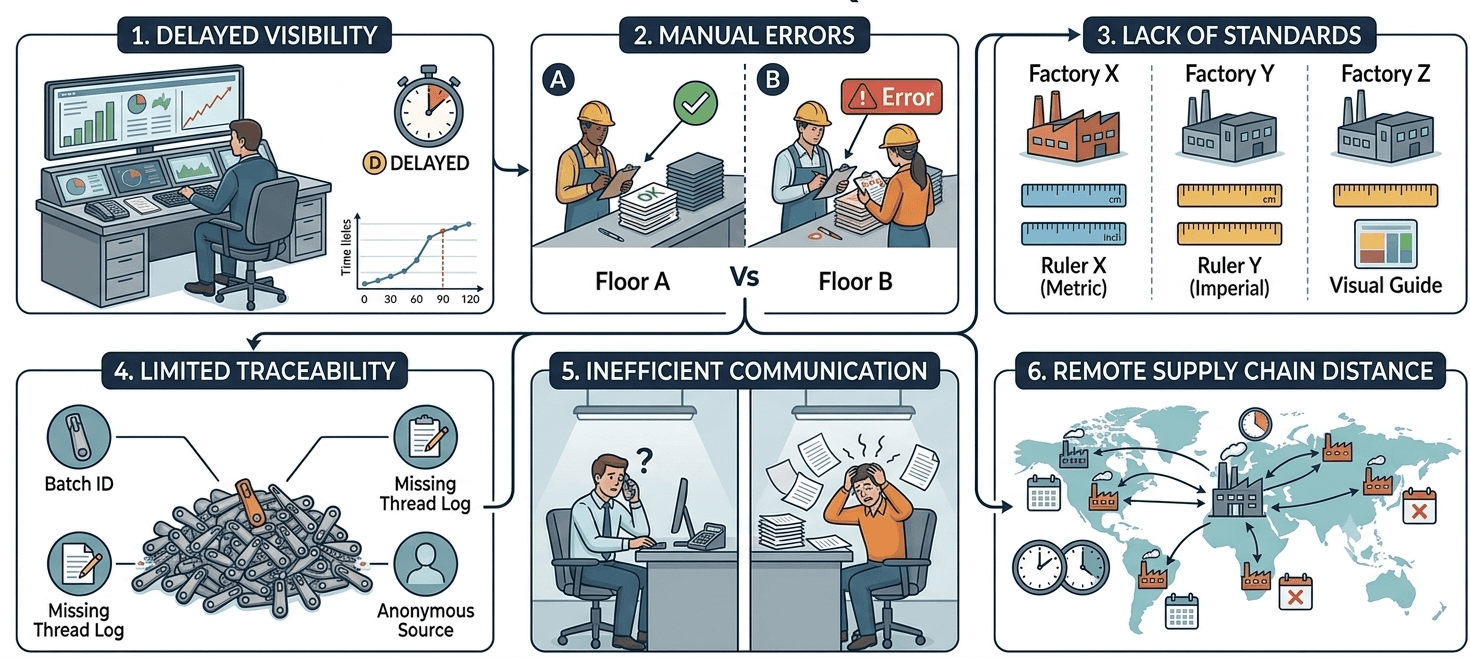
In most factories and sites, garment quality inspection still follows a largely manual and fragmented workflow. Some of the steps and processes remain consistent across factories. However, the way inspections are performed and how data is captured and analyzed often limits speed, accuracy, and visibility.
Key Challenges in Traditional Inspection
1. Delayed Visibility into Quality Issues
Inspection data is often only available after reports are compiled and shared. This delay prevents teams from identifying and addressing issues in real time, especially during production.
2. Manual Errors and Inconsistencies
Paper-based recording increases the risk of human error, incomplete data, and inconsistent defect classification leading to unreliable insights.
3. Lack of Standardization
Different inspectors, factories, or suppliers follow varying formats and criteria that make it difficult to maintain consistency across inspections.
4. Limited Traceability
Tracking defects across production stages or linking them back to root causes is challenging when data is fragmented and manually recorded.
5. Inefficient Communication
Sharing reports across teams, suppliers, and stakeholders often involves back-and-forth communication. But lack of real time data slows down decision-making and corrective actions.
6. Difficulty Managing Distributed Supply Chains
With production spread across multiple vendors and locations, maintaining visibility and control over quality becomes significantly more complex.
For More Details: Learn About Fabric Inspection Challenges and How to Overcome Them
The Essential Need of Digital Quality Inspections
As production cycles accelerate and quality expectations increase, the limitations of traditional inspection methods will become more apparent. The lack of real-time data and visibility not only impacts efficiency but also reduces the ability to make proactive, informed decisions.
To overcome the challenges, brands and manufacturers are increasingly moving toward digital inspection systems. The SaaS-based solutions streamline workflows, standardize data capture, and provide instant visibility into quality performance across production.
QUONDA is a cloud-based apparel quality management software that centralizes, standardizes, and automates the entire inspection network. The advanced dashboard makes it easy to plan, manage, and review all past and upcoming inspections. Brands and manufacturers can even configure QUONDA according to particular inspection workflows and processes.
Developed by Triple Tree Solutions, it has been operational for the last 10 years. QUONDA is trusted by leading international brands, retailers, and sourcing giants across 45 countries for inline and final inspections.
Let us view the 10 Core Digital Features
1. Live Inspection View
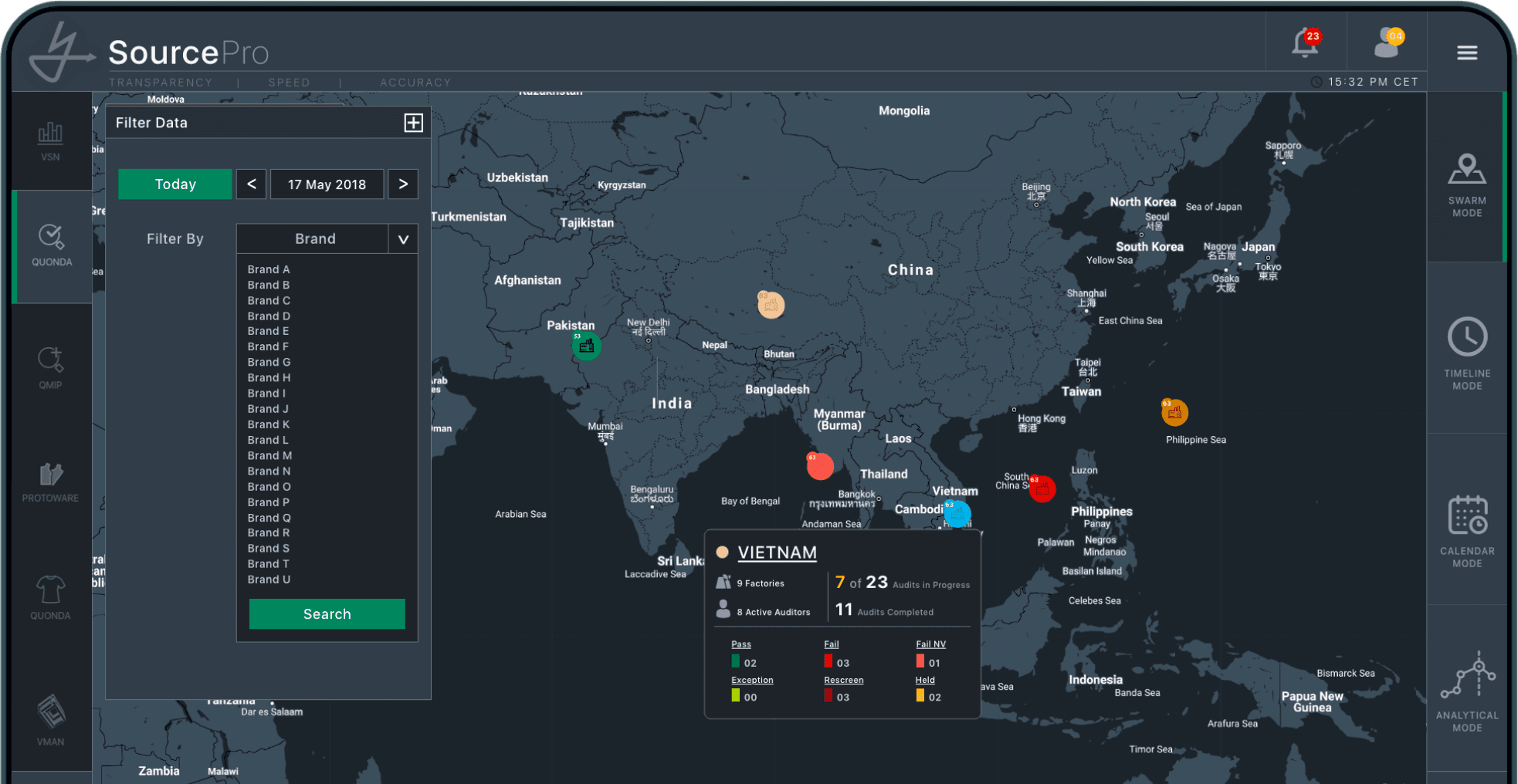
QUONDA replaces the manual clipboard with an intuitive mobile app. It allows inspectors to tap and record defects, sizing parameters, and visual notes directly at the source. Instant data ensure faster inspection, eliminates duplicate entry, and reduces human error.
- Real-Time Audit Streaming
Watch active inspections as they happen across any factory worldwide. See defect counts and AQL status update live on your screen.
- Remote Verification
Review live-uploaded photos of flaws, measurements, and fabric defects from your desk.
2. Customized Inspection Workflow
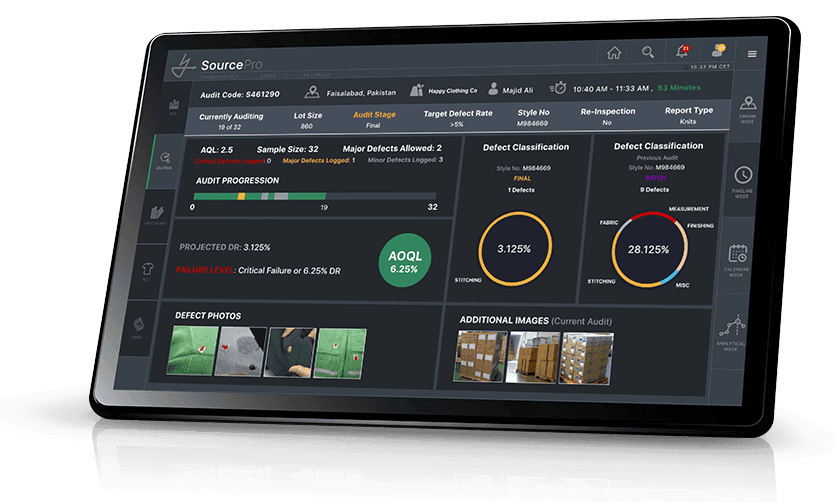
Every brand has a unique DNA, and every garment category requires a distinct auditing touch. QUONDA doesn't force you into a one-size-fits-all box. You can standardize your proprietary inspection rules across various vendors. For example, an inspector in Vietnam executes the exact same strict quality checks as your team in Bangladesh.
- Variable Settings
Set custom inspection parameters for different production milestones. It can be an initial material check, a fast-paced inline sewing audit, or a final random inspection (FRI).
- Mandatory Field Protocols
Enforce strict compliance on the floor by requiring inspectors to upload photos, input specific measurements, or check custom safety boxes before an audit can proceed.
3. Defect Report with CAPA
A defect report without a structured fix is just wasted paper. QUONDA turns negative audit data into an actionable quality recovery guideline that ensures factories fix root causes, not just identify them.
- Automated CAPA Triggers
When an audit fails or a specific defect type hits a warning threshold, the platform instantly generates a formal CAPA request directed straight to the vendor.
- Proof of Rectification Logs
Vendors need to upload photo evidence, updated specification sheets, or mechanic calibration notes to prove the issue has been resolved.
4. Inspection Scheduler
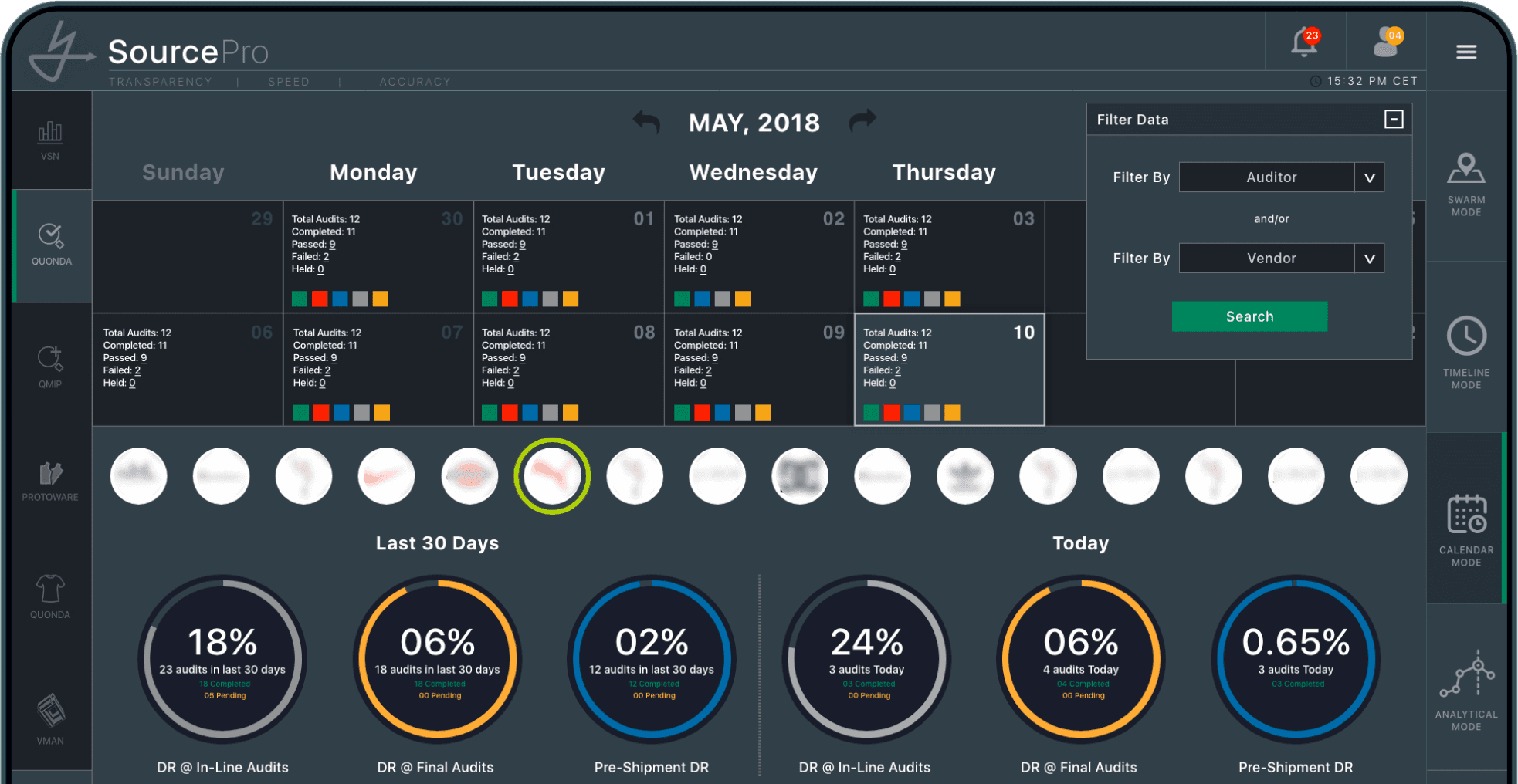
Coordinating inspection dates across an extended supplier base is an administrative hassle. QUONDA centralizes booking, resource allocation, and factory timelines into an operational calendar.
- Smart Booking
Allow vendors or production teams to submit digital inspection requests based on actual start and completion dates.
- Capacity Tracking
Gain instant visibility into production volumes and shipment deadlines to ensure audits are scheduled precisely when a batch hits its required AQL booking volume (e.g. when 80% of an order is fully packed).
5. Manage Audit Schedule
It is necessary to optimize inspector network by allocating resources based on factory proximity and product category expertise. With QUONDA, it is easy to allocate inspection resources and track daily team assignments.
- Geographic and Skill-Based Matching
View a live map of your auditor network and instantly assign jobs based on proximity, current workload, and specific product-category expertise (e.g., assigning a specialized outerwear auditor to a complex technical jacket run).
- Dynamic Re-routing
Instantly shift schedules on a live drag-and-drop calendar interface when production delays happen, or factory timelines unexpectedly slip.
6. Inspector Activity Dashboard
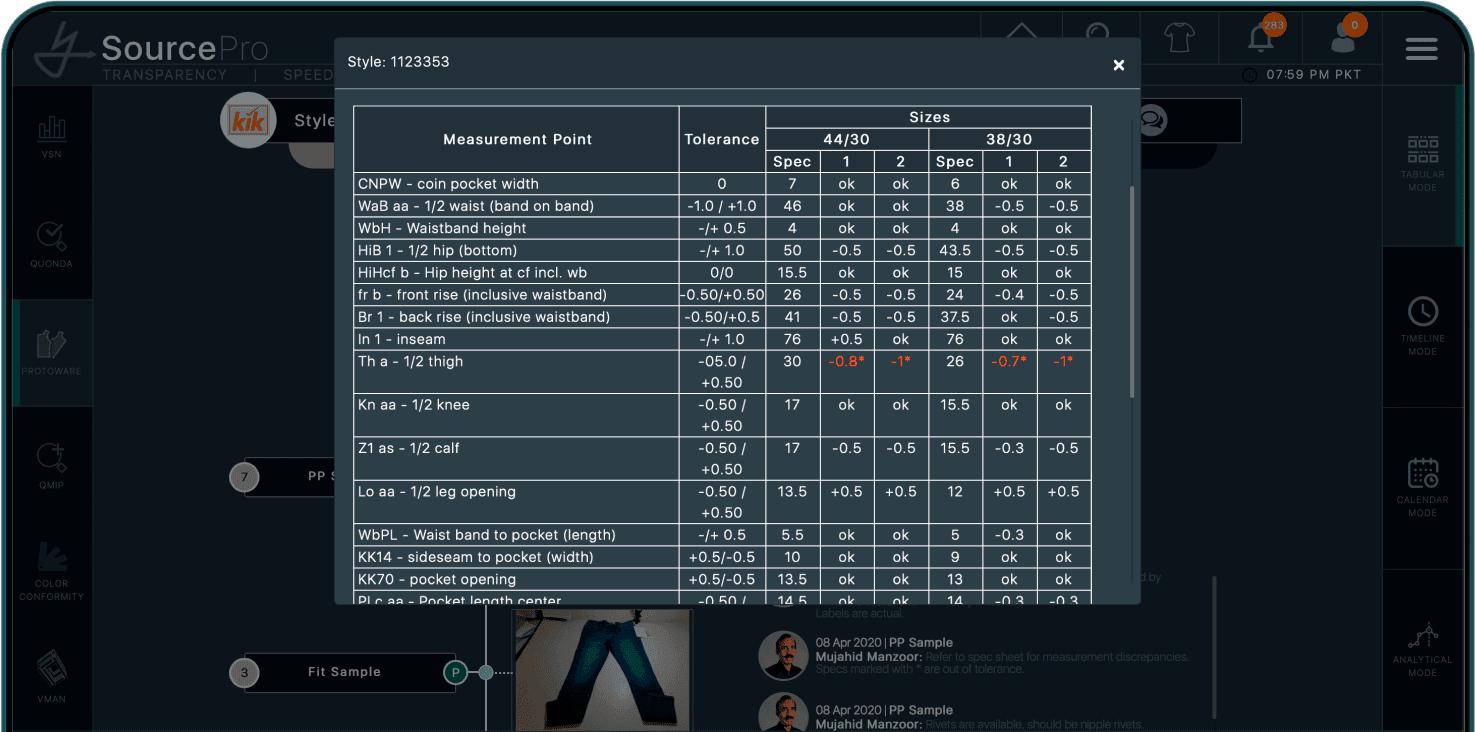
The authenticity of quality data depends entirely on the actions of the inspector. QUONDA provides operational transparency and ability to track how, when, and where every single audit happens.
- Audit Analytics
Track the exact amount of time spent per garment unit or size measurement. Flag outlier audits that were completed suspiciously fast, indicating a potential superficial check.
7. ERP & PLM Integration
Inspectors waste time manually re-typing style numbers, purchase orders (POs), and size charts that already exist inside other software systems. QUONDA integrates seamlessly with your existing PLM and ERP tools.
- Automated Spec and PO Syncing
Pull size sheets, measurement tolerances, vendor names, and PO data directly from your PLM/ERP straight to the inspector’s mobile app that saves considerable time.
- Data Exchange
Automatically push completed inspection scores, pass/fail results, and finalized PDF reports back into your central system of record the moment an audit concludes.
8. Custom Inspection Reports
It takes hours for inspectors to enter and compile reports on audit data. QUONDA replaces the static spreadsheet and complete PDF and digital summaries. A professional, and actionable insight allows executives, vendors, and clients to understand the workflow easily.
- Drag-and-Drop Option
Easily customize your report layouts. Choose exactly how to display images of defects, measurement charts, AQL math breakdowns, and compliance signatures.
- Automated Multi-Format Exporting
Instantly export your audit findings into high-resolution PDFs, interactive web summaries, or raw CSV files with a single click.
9. Dashboard & Analytics
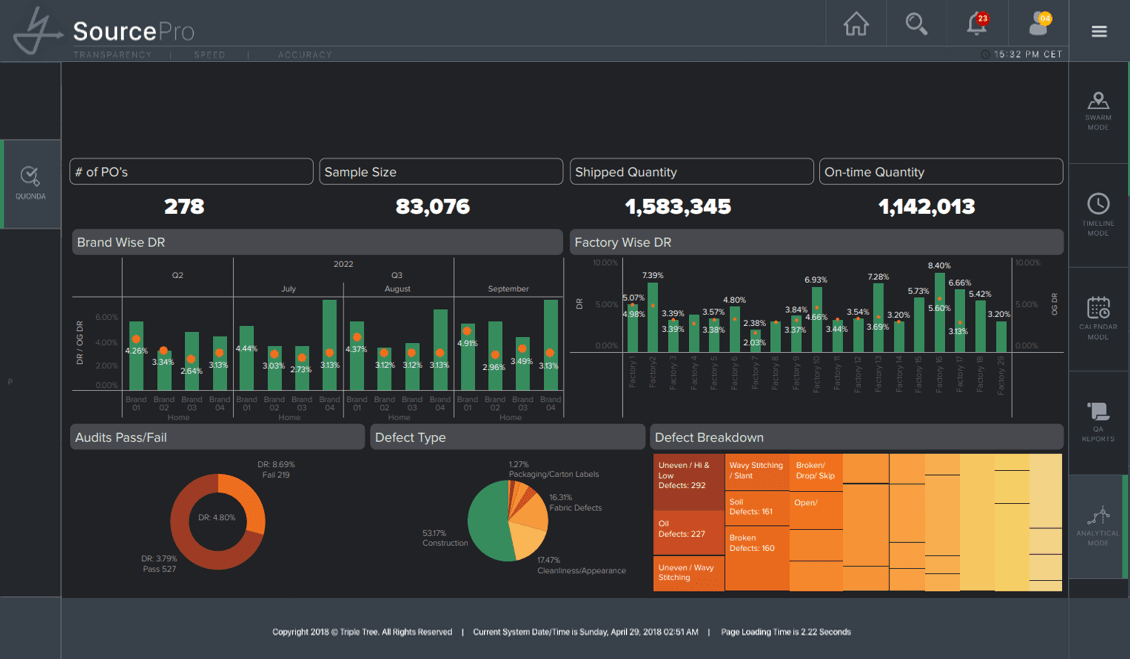
Tons of valuable data is wasted if not used for systemic business growth. QUONDA helps to organize floor logs into clear, visual business intelligence charts that highlight long-term quality trends.
- Macro-to-Micro Performance Views
Monitor average DHU and FPY on dashboard, with the option to drill down into a single factory line with a single click.
- Defect Impact Mapping
Identify recurring defect categories across seasons such as stitching or fabric flaws to know how each is costing your business in scrap material and rework labor.
10. AI Inspector Recommendation and Analytics
Traditional inspection systems lack the ability to analyze data trends or identify root causes of recurring defects. QUONDA leverages data analytics and AI-driven insights to provide best inspector recommendations.
- Dynamic KPI Evaluation
Continually track inspector skills and activity to evaluate their accuracy in spotting critical flaws, historical experience with specific garment categories, and workflow efficiency.
- Combined Score Option
The ‘Combined Score’ provides a holistic view and helps assign the absolute best-suited inspector for any high-complexity audit task.
Key Differences Between Traditional Methods and Digital Inspection with QUONDA
| Aspect | Traditional Inspection | QUONDA |
|---|---|---|
| Data Capture | Paper-based checklists, manual entry | Mobile-based, real-time input |
| Reports | 24 to 48 hours lag time as data is manually compiled | Automated reports go live as the audit completes. |
| Visibility | Fragmented data silos; zero bird's-eye view on inspection workflow | Real-time dashboards and tracking |
| Accuracy | Prone to human error and inconsistency | Standardized and structured data |
| Decision-Making | Reactive, based on delayed insights | Proactive, enabled by real-time data |
| Scalability | Difficult across multiple factories | Easily scalable across locations |
How to Implement a Digital Quality Inspection Software in Apparel Manufacturing
Adopting digital software is not just a technology upgrade; it’s a shift in how quality is managed across production. To ensure a smooth transition from manual processes to a digital workflow, brands need a structured approach that aligns teams, processes, and tools.
Let us view the 7 steps to deploy
Step-1: Assess Current Inspection Processes
Start by evaluating how inspections are currently conducted across your production workflow.
Identify:
- Where inspections take place (inline, final, pre-production)
- How data is captured and reported
- Gaps in visibility, accuracy, and consistency
This helps define clear objectives for solutions like QUONDA and how it can reduce delays, improve accuracy, and help gain real-time insights.
Step 2: Define Standardized Inspection Criteria
Before implementing any system, ensure that inspection standards are clearly defined and documented.
This includes:
- Standard checklists and inspection formats
- Defect classification and severity levels
- Measurement guidelines and tolerances
Standardization is necessary to ensure consistency across inspectors, factories, and production lines.
Step 3: Choose the Right Digital Inspection Platform
Select a SaaS solution that aligns with your operational needs and production complexity.
Key capabilities to look for:
- Mobile-based inspection for on-ground data capture
- Cloud-based access for centralized visibility
- Automated industrial AQL scoring math
- Real-time reporting and dashboards
- Support for inline and final inspections
- Customizable checklists and workflows
A solution like QUONDA integrates these capabilities into a single system and an effective way to manage end-to-end apparel inspections.
Step-4: Digitize Inspection Workflows
Once a platform is selected, convert existing manual processes into digital workflows.
This involves:
- Creating digital inspection templates
- Configuring defect libraries and categories
- Setting up AQL sampling rules
- Defining reporting formats
The goal is to replicate and improve existing processes in a structured, scalable format.
Step 5: Train Inspectors and Teams
Successful implementation depends on user adoption. Inspectors and quality teams should be trained on how to use the system effectively.
Focus areas include:
- Using mobile devices for inspections
- Recording defects and measurements accurately
- Following standardized workflows
Proper training ensures consistency and reduces resistance to change.
Step 6: Start with a Pilot Run
Instead of rolling out across all operations at once, begin with a pilot implementation such as a single production line or factory.
This helps to:
- Test workflows and configurations
- Identify gaps or challenges
- Refine processes before scaling
Step 7: Monitor Performance and Optimize
Once implemented, advanced quality inspections from QUONDA will help to track key performance metrics.
Use insights to:
- Identify recurring issues and improve inspection processes
- Effectively evaluate metrics such as DHU, defect rates, and first pass yield.
- Optimize production quality over time
Learn More: The Complete Review of QUONDA: The Digital Quality Management Solution for Textiles
The Future of Apparel Quality Management
The textile and apparel sectors have lagged behind other major manufacturing industries in rapid digital adoption. The use of slow, manual legacy systems is no longer viable for brands trying to navigate global challenges.
Even McKinsey & Company states that brands that adapt to new technology, consumer behavior, and trade settings will be the winners.
As supply chains evolve, the future of textile and apparel quality inspection is increasingly driven by technology, data, and transparency. Digital quality management in apparel enables brands to move from reactive inspections to proactive quality strategies.
Here are the elements driving the future
Data-Driven Decision Making
Real-time analytics will replace guesswork and enable brands to identify high-risk suppliers and recurring defect patterns across global production hubs.
AI and Automation in Inspections
Artificial intelligence will automate AQL calculations and recommend the best-suited inspectors to reduce human error and subjective grading bias.
Increasing Need for Transparency
With stricter global regulations like DPP, digital logs will be mandatory to provide information trail regarding durability and compliance.
Predictive Risk Mitigation
Advanced algorithms will analyze historical fabric and factory data to predict potential failures before production begins.
IoT-Enabled Hardware
Integration with tools like Bluetooth e-Tapes will be necessary for 100% measurement accuracy and eliminating manual data entry errors.
📖 Case Study: How QUONDA Helped Sourcing Giant Enhance its Operations
Conclusion
We at Triple Tree Solutions believe quality is not a single "pass/fail" event at the end of a production line. It’s a strategic element that begins with a meticulous tech pack and extends through collaborative supplier relationships and inspection stages.
Apparel brands need to understand the technical nuances of AQL standards, garment defects accurately, and root causes of quality issues. Only then can they drastically reduce the quality issues that continue to challenge the fashion sector.
However, the key is shifting from manual, reactive inspection method to proactive, data-driven technology.
Integrating an enterprise quality management solution like QUONDA bridges the data gap between global sourcing offices and factory floors. Features like real-time visibility, AI-driven inspector recommendations, and standardized digital workflows ensure that every garment complies with quality requirements.
Ready to Cut Your Inspection Lead Times by 40%?
Enhance Your Quality Inspection Process to eliminate the information lag and gain end-to-end visibility.
The Apparel Quality Checklist
Use this checklist to evaluate whether your apparel quality control process follows industry best practices.
☐ Pre-Production: Check whether final product specifications, tech packs, and PP samples are approved before bulk production begins.
☐ Raw Material Quality: Are fabrics and trims are inspected and tested for shrinkage, colorfastness, shade consistency, and other quality requirements.
☐ Inline Control: Do inspectors conduct daily, mid-line spot-checks to catch stitching errors in real-time?
☐ AQL Precision: Is sampling size based on international standards (ISO 2859-1)?
☐ Supplier Collaboration: Do your vendors have access to real-time defect data to launch immediate Corrective and Preventive Actions (CAPA)?
☐ Digital Integration: Is the quality data trapped in paper logs, or visible on digital dashboard like QUONDA for real-time decision-making?
TRENDING NOW
Community Favorites
PRODUCTION
The Complete Guide to Apparel Production Tracking & PO Management
Triple Tree Solutions
Jul 29, 2026

Industry Events
What to Expect at PI Apparel’s Fashion Technology Show NYC 2026

Triple Tree Solutions
Jul 15, 2026
QUALITY
The Complete Guide to Textile & Apparel Quality Inspection
Triple Tree Solutions
Jul 2, 2026
PRODUCTION
From Yarn to Shipment: How TrackIT Optimizes Textile Workflow
Triple Tree Solutions
Jun 16, 2026