The Complete Guide to Vendor Management in Apparel and Textile
Managing an apparel supplier network requires more than spreadsheets and email threads. This guide explores the end-to-end vendor management process, from supplier onboarding and audits to performance monitoring and corrective actions. We also discuss how digital solutions like VMAN help apparel brands improve visibility, track performance, and make informed decisions.
Triple Tree Solutions
Published
October 23, 2026
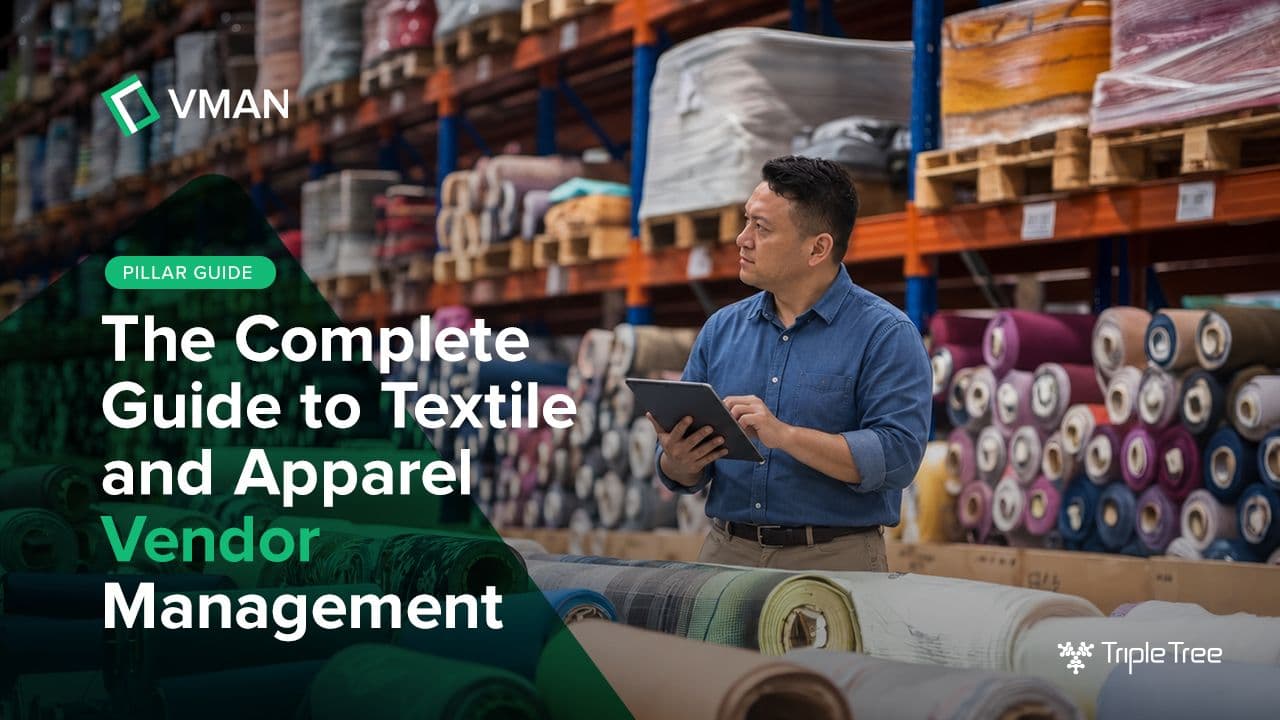
Apparel brands rely on networks of vendors for fabrics, trims, accessories, and garment manufacturing. As multiple vendors are involved, a delay from even one supplier can disrupt the entire production process and put delivery timelines at risk.
The most crucial aspect is that vendor management often relies on spreadsheets, email threads, and disconnected systems. Audit reports, certifications, quality records, and delivery data remain scattered, which makes it difficult to track supplier performance and identify issues.
Moreover, growing sustainability and compliance expectations, tariffs and geopolitical uncertainty are making supplier oversight increasingly complex. Greater visibility and proactive risk management are essential for brands to build a resilient apparel supply chain.
This guide explores vendor management in the apparel and textile industry, from vendor lifecycle and key performance metrics to the limitations of traditional methods. It also examines how a digital solution like VMAN helps centralize supplier data, standardize evaluations, and monitor compliance.
What Is Vendor Management in Apparel and Textile?
It is the process of selecting, evaluating, coordinating, and monitoring the external suppliers that help bring a garment from concept to finished product. It covers everything from sourcing fabrics and trims to managing garment manufacturers, dyeing units, printing facilities, and finishing partners.
Whether a brand outsources garment production or manufactures in-house, it involves multiple external vendors to keep operations running smoothly. Each supplier contributes to a different stage of production.
Instead of relying on relationships and occasional audits, a structured vendor management process evaluates vendors across four key areas
- Performance: Track on-time delivery, product quality, and responsiveness against agreed targets.
- Compliance: Verify that certifications, audit requirements, and social, environmental, and safety standards are met and up to date.
- Capacity: Assess whether vendors can meet required production volumes, lead times, and product specifications.
- Communication: Ensure issues, feedback, and corrective actions are communicated promptly between brands and vendors and properly documented.
Why Vendor Management Matters
In apparel, a brand's quality, delivery, and ethics are only as strong as its weakest supplier. Most companies can see their Tier 1 factories, but visibility drops sharply beyond that. Tier 2 and Tier 3 suppliers are where many environmental and labor risks sit.
Poor vendor oversight has effects far beyond the sourcing team. Late shipments trigger air freight and markdowns. Quality failures drive rework and returns. Compliance gaps can lead to blocked shipments, retailer chargebacks, or lost licenses.
Apparel supply chains often extend beyond the factories as brands work directly with suppliers at various levels
Tier 1: Typically handle finished garment production.
Tier 2: Provide materials and processing, such as fabrics, yarns, dyeing, and finishing.
Tier 3: Operate further upstream, supplying raw materials such as cotton and other fibers.
Each tier introduces additional dependencies, making it harder to maintain visibility into material origins, working conditions, environmental practices, and supplier compliance.
Let us break down the real cost of "getting it wrong."
| Impact Area | Consequence of Poor Visibility and Control |
|---|---|
| Production & Delivery | Material shortages, production bottlenecks, missed deadlines, and delayed shipments. |
| Product Quality | Defective garments, inconsistent materials, rework, rejected batches, and customer returns. |
| Compliance & Traceability | Missing certifications, unresolved audit findings, limited supply chain visibility, and potential order restrictions. |
| Supplier Reliability | Undetected capacity constraints, recurring performance issues, and unexpected supply disruptions. |
| Brand Reputation | Reduced retailer confidence, missed commitments, and reputational damage from sourcing or compliance failures. |
The Three Stages of the Vendor Lifecycle
Effective apparel vendor management is not a single activity. It runs across the whole relationship with a supplier and is divided into three stages: Before, During, and After production. Each stage must reduce risk and help a brand make better sourcing decisions.
Let us explore each stage.
1. Before Production: Selection and Onboarding
This stage focuses on identifying suitable vendors and verifying that they meet the brand's requirements before production begins.
At this stage, teams review:
- Factory profile, ownership, and product capabilities
- Certifications and social or environmental audit history
- Capacity, lead times, and equipment
The objective is to start the relationship on a verified foundation and avoid costly surprises once garment manufacturing begins.
Key Activities
Vendor Qualification: Assess whether the factory can meet quality, volume, and compliance requirements for the intended product category.
Document and Certification Collection: Gather licenses, audit reports, and certificates such as OEKO-TEX, GOTS, or social compliance certifications, and record their expiry dates.
Capacity Assessment: Evaluate whether the vendor can meet the required volumes, technical specifications, material requirements, and delivery schedules.
Approval and Onboarding: Establish contracts, communicate quality expectations, define tasks, and collect essential documentation.
2. During Production: Monitoring and Evaluation
Once orders are placed, the focus moves to watching how the vendor actually performs. Sourcing and quality teams track delivery, quantities, quality results, and compliance status while production is running, not weeks later.
Key focus areas include:
- On-time delivery and order progress
- Quality results from inline and final inspections
- Compliance status and certificate validity
By spotting slippage early, teams can step in with the vendor before a delay or defect becomes a missed shipment.
Key Activities
Production and Delivery Tracking: Monitor production milestones, material availability, order progress, and expected delivery dates to identify potential delays.
Quality Monitoring: Conduct inspections and review defect rates to ensure materials and finished products meet agreed specifications.
Compliance Monitoring: Track certification validity, audit requirements, and outstanding compliance issues throughout the vendor relationship.
Constant Communication: Share feedback and requests through one channel so nothing is lost in email.
3. After Production: Audit, Corrective Action and Renewal
After an order or production cycle is completed, brands review vendor performance. The purpose is to address recurring issues and determine whether the relationship should continue.
This typically involves:
- Follow-up on audit findings
- Corrective Action Plans (CAPs) with owners and deadlines
- Recertification and periodic performance reviews
This stage decides whether a vendor gets more volume, stays on watch, or is phased out.
Key Activities
Performance Review: Compare vendors across regions, categories, and seasons on quality, cost, and compliance results against set expectations.
Corrective Action Management: Document quality failures, missed deadlines, assign responsibility, and track corrective actions.
Vendor Rating and Feedback:: Share performance feedback, and update vendor ratings to support future sourcing decisions.
Renewal or Reassessment: Decide whether to continue, renegotiate, improve, or discontinue the relationship based on performance, results, and risk.
While these stages are standard, the speed at which data moves between them determines the result. Moving from spreadsheets to a vendor management system like VMAN lets each checkpoint happen faster. It helps with onboarding forms, automated reminders, and corrective action tracking working from one vendor to another.
Vendor Evaluation Methods in the Apparel Industry
Evaluating apparel vendors involves more than reviewing their credentials. Brands use a combination of document reviews, factory audits, performance data, and independent assessments to verify a supplier. The methods include
1. Desk-Based Assessment
The most common first step, where teams review documents, questionnaires, and certificates submitted by the vendor.
This includes checking for:
- Business licenses and ownership details
- Valid certifications and prior audit reports
- Self-assessment questionnaires
It is a quick method for initial screening, but vendor questionnaires and certificates should be verified.
2. On-Site Audits
Auditors visit the factory to verify conditions in person.
Typical checks include:
- Working conditions, hours, and safety
- Environmental practices and chemical handling
- Production capacity and equipment
On-site audits provide direct observations at a particular point in time. However, some issues may not be visible during a single visit.
3. Performance Data Review
The vendor is judged on actual results over time rather than on a single visit.
Typical inputs include:
- On-time delivery history
- Inspection results and defect trends
- Corrective action closure speed
This method shows how a vendor behaves day to day, and it is the basis for scorecards and benchmarking.
4. Third-Party Audits and Certifications
Independent bodies verify that a vendor meets recognized standards, which adds credibility and reduces duplicated audits. Brands still need to track when each certificate expires and what findings remain open.
In most organizations these methods generate documents scattered across inboxes and drives, which makes it hard to see a vendor's full picture. A digital platform brings the results of all four into one profile and one score.
Turning Audit Findings into a Vendor Score
Audit results are most useful when they are converted into a score that can be compared across vendors. A weighted scorecard allows brands to compare suppliers against defined criteria, identify performance gaps, and determine which vendors need closer monitoring
Here is an illustrative example on how a brand evaluates vendors using four weighted categories:
| Evaluation Category | Weight | Vendor A's score | Weighted Contribution |
|---|---|---|---|
| Compliance | 35% | 90/100 | 31.5 |
| Quality | 30% | 80/100 | 24 |
| Delivery | 25% | 85/100 | 21.25 |
| Responsiveness | 10% | 70/100 | 7 |
| Total | 100% | - | 83.75/100 |
The weighted score is calculated by multiplying each category score by its assigned weight and adding the results.
For illustration, suppose the brand's approval threshold is 80 and its watchlist threshold is 65.
Vendor A's score of 83.75 qualifies it as approved, but its responsiveness score of 70 signals an area for improvement. The brand can set a targeted improvement plan while retaining the vendor's approved status.
Note: These weights and thresholds are illustrative. Brands should define criteria that reflect their sourcing priorities and compliance requirements. Critical compliance failures may also require immediate corrective action regardless of the overall score.
The Vendor Audit Cycle
A structured audit cycle helps brands move from identifying problems to verifying that they have been resolved.
Here are the steps to ensure them
1. Plan the Audit
Schedule audits by risk level, product category, previous findings, and certificate expiry dates.
2. Conduct the Audit
Use a standardized checklist to assess vendors consistently against applicable requirements.
3. Record Findings
Document each finding with supporting evidence, a severity level, and the responsible party.
4. Assign Corrective Actions
Define the actions needed to address each non-conformance, along with clear owners and deadlines.
5. Verify and Close
Review evidence from the vendor to confirm that corrective actions are effective and formally close the finding.
The Common Vendor Issues and Compliance Gaps
Understanding where vendor problems arise helps apparel brands establish effective checks, prioritize risks, and address issues before they disrupt production. These issues can occur at any stage of the vendor lifecycle and fall into the following categories.
Let us view them.
1. Delivery and Capacity Issues
- Late Shipments: Orders that miss agreed ship dates and disrupt retail calendars.
- Over-Commitment: A vendor accepting more orders than it can handle.
- Quantity Mismatches: Shipped volumes that differ from the order.
2. Quality Issues
- High Defect Rates: Recurring defects that appear across multiple orders.
- Repeat Inspection Failures: The same problems found again after corrective action.
- Inconsistent Output: Quality that varies between lines or factories.
3. Documentation and Certification Gaps
- Expired Certificates: Lapsed social, environmental, or chemical safety certifications.
- Missing Records: Incomplete audit reports or test documents.
- Outdated Vendor Profiles: Changes in ownership, capacity, or subcontractors that were never updated.
4. Social and Ethical Violations
- Excessive Working Hours: Overtime beyond legal or brand limits.
- Safety Violations: Blocked exits, poor fire safety, or missing safety equipment.
- Wage or Worker Rights Issues: Underpayment or restrictions on worker rights.
5. Environmental and Chemical Compliance Issues
- Improper Waste or Effluent Handling: Discharge that breaks local rules or brand standards.
- Restricted Substance Failures: Chemicals outside allowed limits.
6. Critical Issues
Issues that pose serious legal or reputational risk and require immediate action.
- Unauthorized Subcontracting: Orders transferred to factories that have not been declared or approved by the brand.
- Limited Upstream Visibility: Missing information about fabric mills, yarn suppliers, raw material sources, or other upstream vendors.
- Unverified Material Origins: Inadequate records to substantiate material origin or support applicable forced-labor and traceability requirements.
- Child or Forced Labor: Violations that can lead to shipment seizure and public exposure.
The Key Vendor Performance Metrics
Vendor management is not only about finding problems. It is about measuring performance, tracking trends, and improving over time. Without clear metrics, vendor data stays fragmented and hard to act on.
Let us view the key metrics.
1. On-Time Delivery Rate (OTD)
OTD measures the share of orders shipped on or before the agreed date.
Formula:
(Orders Delivered On Time / Total Orders) × 100
A low OTD points to planning, capacity, or material sourcing problems. It is one of the first metrics buyers look at.
2. Quality Performance
This measures how vendors perform in inspections, such as the inspection pass rate or defects per hundred units (DHU).
Formula (pass rate):
(Inspections Passed / Total Inspections) × 100
Linking inspection results to vendor scorecards ensures that quality data from tools like QUONDA feeds into sourcing decisions. For more detail, read our guide to textile and apparel quality inspection.
3. Compliance Score
This reflects how well a vendor performs against audit criteria and certification requirements.
A falling compliance score is an early warning that a vendor needs support or closer monitoring.
4. Corrective Action Closure Rate and Time
This tracks how many corrective actions are closed on time and how long they take.
Formula:
(Actions Closed by Deadline / Total Actions Raised) × 100
Slow closure is a sign of weak accountability, even if the audit score itself looks fine.
5. Capacity Utilization
This compares booked volume against a vendor's available capacity.
Formula:
(Booked Volume / Available Capacity) × 100
Very high utilization raises delay risk, while very low utilization may signal financial or demand problems at the vendor.
6. Certification Validity Rate
This measures how many required certifications are current at any time.
Formula:
(Valid Certifications / Required Certifications) × 100
It prevents the common situation where a certificate expires unnoticed and shipments are put at risk.
7. Cost Variance
This compares the actual landed cost against the planned cost.
Formula:
((Actual Cost − Planned Cost) / Planned Cost) × 100
It exposes the hidden cost of delays, rework, and air freight that never show up in the unit price.
Together, these metrics can be weighted into a single composite vendor scorecard, which lets teams compare suppliers fairly across regions, categories, and seasons. Tracking them in a shared system rather than separate spreadsheets is what makes the comparison reliable.
Traditional Vendor Management Tools and Workflow
For decades, vendor management in apparel has run on basic, manual tools. They are familiar and cheap, but they offer limited support for real-time data and decision-making.
Here are the common tools:
Spreadsheets:
The default for vendor lists, scorecards, and audit trackers. They are flexible, but versions multiply, formulas break, and nobody can be sure which file is current.
Email Threads:
Used to request documents, share audit findings, and chase corrective actions. Important information gets buried, and there is no single record of what was agreed.
Shared Drives and Folders:
Store certificates, audit reports, and contracts. Expiry dates are not tracked, so a lapsed certificate is often discovered only when someone needs it.
Paper or PDF Audit Reports:
Primary evidence of audits, but the findings are rarely connected to actions or trends.
The Traditional Vendor Management Workflow
The typical process involves several manual steps across the vendor lifecycle.
Vendor Onboarding:
Teams email forms and collect documents one vendor at a time, then enter the details into a spreadsheet.
Audit Scheduling:
Audit dates are tracked on calendars or lists, with reminders set by hand.
Manual Data Recording:
Findings and scores are typed into spreadsheets, often by someone who was not at the audit.
Report Compilation:
Performance and compliance reports are assembled from several sources before each review meeting.
Follow-up and Decision-Making:
Corrective actions are chased by email, and sourcing decisions are made on partial or outdated information.
The Challenges in Traditional Vendor Management
Managing a global supplier base means juggling dozens of moving parts. A single oversight can derail a season, and manual workflows make oversights more likely.
Let us view the most prominent challenges
1. Lack of Vendor Visibility
Fragmented data makes it nearly impossible to see real-time supplier performance and production status across factories. Teams find out about problems after they have already hit the schedule.
2. Compliance and Audit Complexity
Evolving ESG and ethical sourcing requirements create a heavy administrative burden. Keeping every vendor "audit-ready" through manual tracking is slow and error-prone.
3. Manual Data and Fragmented Systems
Spreadsheets and emails create data silos, duplicate entry, and human error, with no single source of truth.
4. Inconsistent Vendor Performance
Without a standard evaluation method, vendors are judged differently by different people. The result is late deliveries and uneven quality that surface too late.
5. Slow Corrective Actions
Without automated workflows, issues found in audits can take weeks to be assigned and addressed, and sometimes are never formally closed.
6. Limited Sub-Tier Traceability
Most brands lack visibility into Tier 2 and Tier 3 suppliers, where some of the highest environmental and labor risks sit.
7. Hidden Costs
Untracked delays, material waste, and emergency air freight quietly raise the landed cost of garments.
As sourcing networks grow and compliance expectations rise, the limits of manual vendor management become harder to ignore. Missing real-time data affects efficiency and reduces the ability to make proactive decisions. To overcome these challenges, it is necessary for brands to integrate digital vendor management software.
How VMAN Helps Brands Gain Visibility and Control Over Vendors
VMAN is a customizable vendor management and compliance platform developed by Triple Tree Solutions.
It brings together vendor onboarding, certification tracking, audit management, corrective actions, performance evaluation, and reporting. The advanced features support different stages of the vendor lifecycle and help apparel brands manage supplier relationships with greater visibility and consistency.
Let us view those features.
1. Centralized Vendor Profiles
Managing supplier information across spreadsheets and email threads makes it difficult to maintain accurate, up-to-date records. VMAN provides a centralized vendor profile for storing supplier details, factory information, certifications, qualifications, and compliance history.
The digital onboarding forms allow vendors to submit and update their information directly. This reduces manual data entry and helps sourcing and compliance teams work from updated details.
2. Vendor Performance Scorecards
Comparing vendors is not easy when teams use different evaluation criteria or rely on individual judgments. VMAN enables the assessment of suppliers against predefined KPIs, performance trends, and compliance criteria.
Scorecards help evaluate vendors using criteria relevant to the brand's sourcing requirements. Brands can use the data to identify recurring issues and look for improvement.
3. Vendor Audits and Compliance Monitoring
Apparel brands must track audit requirements, certifications, and compliance findings across their supplier base. VMAN helps schedule, record, and monitor vendor audits. Brands can also track certification expiration dates and flag requirements that need attention.
4. Corrective Action Plans (CAPA)
Identifying an issue is only the first step; brands need to ensure vendors address it and prevent it. VMAN supports corrective action tracking by allowing teams to document findings, assign responsibilities, establish deadlines, and monitor progress through closure.
Learn more: Corrective Action Plan for Vendors
5. Vendor Quantity Management and Tracking
Order quantities and production commitments must be aligned with vendor capacity and delivery expectations. With VMAN, teams can compare ordered quantities with reported production and shipment volumes. They can also monitor commitments to help identify potential over-allocation.
6. Vendor Benchmarking and Performance Comparison
A supplier's performance is easier to assess when it can be compared with relevant vendors over consistent periods. VMAN supports vendor benchmarking across categories, regions, and performance criteria. This helps to Identify vendors that consistently meet expectations and those that may need improvement.
7. Visual Analytics and Compliance Maps
Reviewing multiple performance indicators in spreadsheets can make trends difficult to interpret. VMAN's visual reporting features, like spider charts and compliance maps, help teams view supplier performance and compliance status more clearly.
8. Vendor Reporting and System Integration
Preparing vendor reports manually can require information to be collected from multiple sources, which is time-consuming. VMAN help generate structured summaries to support internal reviews and suppliers. Brands can even integrate with ERP and PLM systems to reduce duplicate data entry.
How to Implement Vendor Management Software in Apparel Sourcing
Adopting a vendor management system is not just a technology upgrade. It changes how supplier relationships are run. To make the move from manual to digital smooth, brands need a structured approach that aligns teams, processes, and tools.
Let us view the 7 steps to deploy.
Step 1: Assess Current Vendor Management Processes
Start by looking at how vendors are managed today.
Identify:
- How vendors are onboarded, audited, and evaluated
- Where data lives and who owns it
- Gaps in visibility, follow-up, and consistency
This defines clear objectives for a solution like VMAN and shows where it can reduce delays and manual work.
Step 2: Define Standardized Evaluation Criteria
Before any system is configured, document how vendors will be judged.
This includes:
- Scorecard KPIs and weightings
- Audit checklists and severity levels
- Thresholds for approved, watchlist, and escalated vendors
Standard criteria make results comparable across vendors, regions, and teams.
Step 3: Choose the Right Vendor Management Platform
Select a solution that fits your operational complexity.
Key capabilities to look for:
- Centralized vendor profiles and self-service onboarding
- Configurable scorecards and evaluation criteria
- Audit tracking and corrective action management
- Automated reminders and compliance alerts
- Dashboards, benchmarking, and automated reports
- ERP and PLM integration
A solution like VMAN brings these capabilities into one system and supports configurable workflows by vendor, category, distribution channel, or season.
Step 4: Digitize Vendor Workflows
Convert manual processes into digital workflows.
This involves:
- Setting up vendor profiles and onboarding forms
- Configuring scorecards, audit templates, and CAP workflows
- Defining reminder rules for certifications
- Setting reporting formats
The goal is to replicate and improve existing processes in a structured, scalable format.
Step 5: Train Internal Teams and Vendors
Adoption depends on people. Both your own teams and your vendors need to know how to use the system.
Focus areas include:
- How vendors update profiles and upload certificates
- How teams review scorecards and assign actions
- How corrective actions are submitted and verified
Clear training reduces resistance to change and keeps data accurate.
Step 6: Start with a Pilot Run
Instead of moving the whole supplier base at once, begin with a pilot, such as one region, product category, or group of key vendors.
This helps to:
- Test workflows and configurations
- Identify gaps before scaling
- Build confidence among teams and vendors
Step 7: Monitor Performance and Optimize
Once live, use the data to keep improving.
Use insights to:
- Identify recurring issues and weak vendors early
- Track metrics such as OTD, compliance score, and CAP closure rate
- Refine scorecards and thresholds as your sourcing strategy evolves
VMAN is built for quick implementation, and customers typically begin seeing results within a few weeks, with onboarding training and ongoing support.
Learn More: How VMAN Optimizes Vendor Management for Apparel and Textile Brands
The Future of Vendor Management in Apparel
The textile and apparel sector has been slower than other manufacturing industries to digitize. Manual, siloed vendor management will not hold up against rising compliance expectations and supply chain volatility. Brands that move first will have better data, faster response, and stronger supplier relationships.
Here are the elements driving the future.
Data-Driven Sourcing Decisions
Scorecards and benchmarking will replace gut feel, helping brands allocate volume to vendors with proven delivery, quality, and compliance records.
Predictive Supplier Risk
Trend data from audits, delivery, and quality will help flag at-risk vendors before an issue disrupts production.
Regulation-Driven Transparency
Due diligence rules and the EU Digital Product Passport will push brands to hold verifiable records on suppliers and materials.
Deeper Sub-Tier Visibility
Brands will extend oversight beyond Tier 1 to the mills and material suppliers behind them.
Connected Supply Chain Data
Vendor data will work together with quality, production, and color data. Tools like QUONDA for inspection and TrackIT for production tracking feed the vendor picture, while ColordesQ supports color approvals.
Conclusion
Vendor management works best as a continuous practice, not an annual audit or a spreadsheet exercise. When brands have clear standards, shared data, and accountability on both sides, they can see how vendors are performing, which metrics matter, and where compliance gaps come from, and fix them before they cause delays, quality problems, or compliance surprises.
The shift is from scattered, reactive tracking to a connected, data-driven approach. A vendor compliance management and performance platform like VMAN brings onboarding, scorecards, audits, corrective actions, and reporting into one system, so every team and every vendor works from the same information.
Want to Simplify compliance, digitize workflows, and improve vendor performance with real-time visibility.
The Apparel Vendor Management Checklist
Use this checklist to evaluate whether your vendor management process follows industry best practices.
☐ Vendor Onboarding: Are vendors qualified and approved with verified documents, capacity, and certifications before the first order?
☐ Standard Scorecards: Is every vendor evaluated on the same KPIs, such as OTD, quality, and compliance?
☐ Audit Calendar: Are audits scheduled by risk level and tracked to completion?
☐ Certification Expiry Alerts: Are you warned before certificates lapse, not after?
☐ Corrective Action Closure: Does every finding have an owner, a deadline, and a verified closure?
☐ Sub-Tier Visibility: Do you know which mills and subcontractors sit behind your Tier 1 vendors?
☐ Digital Integration: Is vendor data trapped in spreadsheets, or visible on a dashboard like VMAN that connects with your ERP and PLM?
TRENDING NOW
Community Favorites

INSIGHTS
Supplier Quality Management for Apparel: Audit Guide
Triple Tree Solutions
Oct 27, 2026
INSIGHTS
Apparel Supply Chain Management Software: 4 Best Solutions

Triple Tree Solutions
Oct 15, 2026

COLOR
The Complete Guide to Color Management in Textile & Apparel
Triple Tree Solutions
Oct 6, 2026
COLOR
The Complete Guide to Color Management in Textile & Apparel
Triple Tree Solutions
Oct 6, 2026