The Complete Guide to Color Management in Textile & Apparel
Selecting colors across multiple product lines every season is just the first step. However, submitting and approving particular shades is far from simple. Let us walk you through the end-to-end color management process and explain why physical lab dips are inefficient and cause delays. Also, how digital solutions like ColordesQ streamline approvals, reduce reworks, and accelerate time-to-market.
Triple Tree Solutions
Published
October 6, 2026
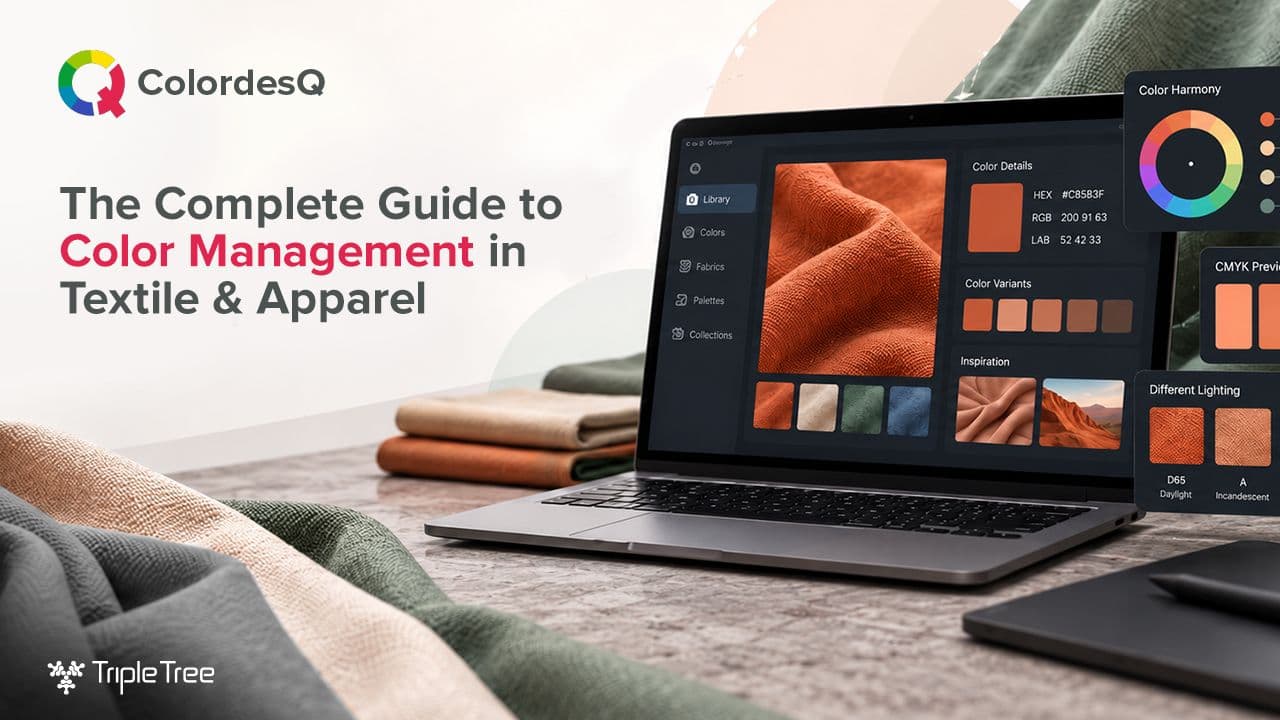
In the textile and apparel industry, color is not just a design element but defines brand identity and product quality. Yet, achieving consistent color accuracy across each new season, and multiple product lines remain quite challenging. A shade that dyes true on cotton can shift entirely on a poly-blend. Similarly, a match approved under a fluorescent light can appear different under the sunlight.
In today’s competitive market, "close enough" is not good enough. Even a minor color mismatch leads to additional lab dips, approval delays, costly re-dyeing, rejected lots, and excessive material waste.
Let us break down the complete color workflow in the industry and see why traditional workflows are not adequate. We also discuss how an advanced digital color management solution like ColordesQ streamlines spectral approvals, ensures quality standards, and eliminates color mismatches.
What Is Color Management in Textile & Apparel?
Color management is the set of processes, standards, and tools that brands and suppliers use to define, evaluate, and approve color. The goal is to maintain the target color which spans four stages:
- Definition: Setting the target color standard a supplier must match, which is usually for a specific fiber, fabric construction, and finish
- Development: The supplier's attempts to achieve the standard through lab dips, strike-offs, or print trials
- Evaluation: Comparing developed samples against the standard visually and with spectral data
- Approval: Sign-off at both the lab dip and bulk production stages
Types of Color Standards Brands Work From
In the apparel supply chain, not every color job starts from the same reference point. The type of standard used affects how effectively a match can be achieved.
- Physical standards: A swatch, garment, or trim sample the brand has physically approved and retained as the master reference
- Digital/spectral standards: A color defined by its spectral curve or Lab* values, with no physical counterpart required
- Library standards: A previously approved color reused across seasons or styles that can be drawn from the existing color library
- Third-party color system standards: References from standardized color systems supported by most labs and mills globally
If a brand relies more on physical standards, it means dependence on shipping, storage, and ensuring each swatch remains accurate. It is one of the reasons why digital, spectral-based standards are becoming necessary for brands operating at scale.
Who's Involved in the Color Management Process
Color management is a process that moves through several roles on both the brand and supplier side that are
- Designers: Select and specify the initial color direction
- Colorists: Translate that direction into achievable formulations and evaluate submissions
- Lab technicians (supplier side): Formulate and measure lab dips
- Merchandisers and product managers: Track color jobs against the broader production calendar
- Quality managers: Verify bulk production against approved standards
- Sourcing and procurement teams: Coordinate across multiple suppliers producing the same or similar colors
The Key Elements of Color Job Process
A modern color management strategy involves several technical concepts. Understanding the terms helps to measure color objectively.
Color Standards
A color standard is a defined reference against which a sample is evaluated. Digital color standards can provide a centralized reference that teams and suppliers can access consistently.
Spectral Data
Spectral data describes how a material interacts with light across different wavelengths. The spectrophotometer measures it and allows color comparisons to be based on measurable characteristics rather than human perception. The data becomes the basis for a pass/fail decision.
Illuminants
Different light sources such as daylight, fluorescent store lighting, and incandescent are used for evaluation. The sample is tested under several standard light sources to prevent metamerism before it is approved.
Delta-E
Delta-E (ΔE) is the numeric value representing the difference between a measured color and its standard. The lower the number, the closer the match.
However, Delta E should not be viewed in isolation. Appropriate tolerances, measurement conditions, material characteristics, and visual evaluation matters for an effective approval process.
Color Tolerances
Not every production result will be mathematically identical to a target. A tolerance defines the acceptable range of variation for a particular color. Different brands, materials, products, and applications may require different tolerance criteria.
Shade Variation
Shade variation refers to differences in color between materials, pieces, rolls, batches, or production lots. Monitoring variation helps brands understand whether production remains within acceptable limits.
Right-First-Time Approval
Right-first-time performance measures how often a submission is approved without requiring another development cycle.
For example:
Right-First-Time Rate = First-Submission Approvals ÷ Total Submissions × 100
Why Color Management Matters
Color inconsistency is not just a cosmetic issue, but most importantly a financial one. A rejected lab dip means another sample, another shipment, and another week added to the development calendar. A bulk run that drifts from the approved standard means markdowns, chargebacks, and a return once the product reaches a customer.
According to 2023 Coresight Research among survey of 60 of U.S. apparel companies, 16% cited color as top reason for online returns.
A supplier may successfully match a lab dip to a target color. But if that color data is not centralized, the supplier will set varying tolerances. As a result, bulk fabric will deviate from the approved sample and overall quality control process will fail.
Color accuracy and consistency become a hassle for a brand working with dozens of suppliers, hundreds of styles, and multiple substrates per season.
The impact of a color mismatch is end-to-end
- Development cost: Every additional lab dip round consumes lab time, dye, fabric, and courier spend
- Calendar risk: Color approval sits on the critical path; a delayed color sign-off pushes back cutting, sewing, and shipping dates downstream
- Markdowns and returns: Bulk shade drift that isn't caught early reaches the consumer, damaging both margin and brand perception
- Supplier relationships: Repeated rejections without clear, data-backed feedback strain vendor partnerships and slow future collaboration
- Environmental cost: Every physical sample shipped and every re-dye adds unnecessary emissions and material waste to a process that, in principle, shouldn't need either
The pressure is only increasing due to faster fashion cycles, growing SKU counts, and negative environmental footprint of apparel production. Brands can no longer rely on traditional, subjective methods to finalize color. The color job must be measurable, trackable, and fast.
The Color Development & Approval Process (Step by Step)
While specific processes vary by organization, a typical textile and apparel color workflow follows several stages.
1. Establish the Target Color
The brand defines the target color which is usually
- a physical reference
- a standardized color library
- spectral data; or
- a combination of physical and digital references.
The color specifications are shared with the supplier, along with the intended substrate, finish, and any known tolerance requirements. The brand needs to communicate the specifications clearly to ensure fewer development rounds.
2. Lab Dip Development
The supplier formulates and dyes small fabric samples "lab dips" to match the standard on the specified substrate. It is where a supplier's expertise and dye recipe matters most as different fiber contents absorb dye differently. The same target shade may require an entirely different formulation depending on the fabric.
3. Lab Dip Submission & Measurement
Lab dips are measured against the standard, either visually under a light box or with a spectrophotometer that captures spectral data. The physical sample is then packaged and shipped to the brand for review.
4. Brand Evaluation & Approval/Rejection
The brand's design or quality team reviews the results. The submitted lab dip is compared against the target standard visually and against any measured tolerance. If the lab dip falls within tolerance, it's approved for bulk. If not, the supplier needs to reformulate and submit another sample.
In traditional workflows, a single color goes through three, four, or even five rounds before approval. Each cycle means additional time, material waste, and cost.
5. Bulk/Production Dyeing
Once a lab dip is approved, the supplier scales the recipe to bulk dye lots. The approved color standard becomes the reference against which production output should be evaluated.
6. Bulk Sample Verification
Production samples are pulled from the bulk run and measured against the approved lab dip to confirm lab-to-bulk consistency. It is a step that catches the metamerism and batch-variation issues that don't show up until scale. Skipping this step can lead to shade complaints after a shipment has already left the factory.
7. Final Shipment Approval
The brand signs off on the bulk shipment to close the loop on the color job. This approval is often the final checkpoint before cutting begins. The data can be used to analyze supplier performance, recurring color deviations, approval timelines, and other operational trends.
The Common Challenges in Textile Color Management
Color consistency means controlling multiple variables simultaneously, which becomes difficult as product complexity and supply-chain scale increase. A delay in one area such as a slow courier shipment makes every downstream issue more expensive to fix.
Here are the challenges that brands and suppliers have to often face.
Subjective Color Assessment
The color evaluation process traditionally involves visual comparison. However, it is influenced by the observer, environment, lighting, surrounding colors, and viewing conditions.
Two people may describe the same color difference differently. A supplier may receive feedback such as "slightly too red" or "a little darker." But translating that subjective description into a precise formulation is difficult.
Metamerism and Lighting Conditions
Two samples can appear identical under one light source and visibly different under another. For example, a fabric and trim may appear similar in a sample room but show a noticeable difference under retail lighting or sunlight.
This makes problems for:
- Multi-component garments
- Color-blocked products
- Retail presentation
- Product photography
- Consumer perception
Without testing across multiple illuminants, mismatches that pass in the lab can surface on the sales floor.
Lengthy Approval Cycles
The physical swatches are frequently shipped between brands and suppliers across different countries and time zones. The back and forth add days or weeks for a lab dip cycle. Since most colors require more than one round to get right, the delay compounds quickly.
Lab-to-Bulk Color Variation
Approving a lab dip does not guarantee that the same color will be reproduced during bulk production.
Production introduces additional variables, including:
- Larger dye lots
- Different production equipment
- Material variation
- Process conditions
- Finishing
- Batch-to-batch differences
For this reason, brands need visibility not only into lab-dip results but also into how production outcomes compare with approved standards.
Multiple Fabrics and Substrates
The same target color needs to appear across:
- Different fabrics (cotton, polyester, nylon)
- Thread
- Labels
- Trims
- Zippers
- Buttons
- Accessories
Different materials can respond differently to dyes and finishing processes. A supplier working across substrates for a single collection needs to reformulate the dye recipe for each one. This multiplies the number of variables and increases the chances of a mismatch for what the brand sees as a single, unified color.
Scattered Data
Color information is usually distributed across:
- Physical swatches
- Spreadsheets
- Email threads
- Lab reports
- PLM systems
- Supplier systems
When teams cannot easily access the same current color standard and approval history, the risk of inconsistent decisions increases.
Supplier Coordination
Without a centralized platform and workflow, communication between a brand and a supplier is fragmented.
Teams struggle to determine:
- Which color standard is current
- Which lab dip was approved
- Why a submission was rejected
- What tolerance was applied
- Who needs to take action
- Whether bulk production matches the approved result
The feedback on why a lab dip fails is often vague like 'too warm' or 'not quite right'. This leaves suppliers to guess rather than make precise adjustments.
A digital color management solution can streamline the color job and provide greater visibility across stakeholders.
High Cost and Environmental Impact of Physical Sampling
Physical sampling involves more than just development time. Each sample, revision, and rework cycle can add to courier expenses as well as the carbon footprint. The apparel and textile industry accounts for roughly 2% to 8% of global carbon emissions. Subsequently, the lab dips and express air freight drive the scope 3 emissions and chemical waste.
What Is Digital Color Management?
It is a process that involves software, color data, and digital workflows to manage color development and quality control.
Instead of shipping a swatch and waiting days for a decision, a supplier can measure a lab dip with a spectrophotometer and upload the spectral data to a shared platform. An objective, tolerance-based result is achieved within the same day, and edits can also done without additional lap dips.
The core components of a digital color management system are:
- Centralized color library where every approved standard is stored digitally and accessible to teams from the brand and supplier
- Spectral data capture and comparison that replaces visual judgment with measurable ΔE values
- Multi-illuminant testing that run automatically rather than manually across separate light boxes
- Configurable tolerance bands which set once per brand or per program can be applied consistently across every job
- Real-time notifications and communication that replace scattered email threads with a single, traceable record per color job
- Dashboards and analytics to give visibility into approval timelines, rejection rates, and supplier performance
| Traditional Workflow | Digital Color Management |
|---|---|
| Physical sample shipping | Digital submission of measured spectral data |
| Subjective visual judgment | Objective color data |
| Scattered communication | Centralized platform with notifications and comments |
| Single-light assessment | Multi-illuminant metamerism checks |
| Manual tracking in spreadsheets | Real-time dashboards and supplier KPIs |
| Slow, multi-round approval cycles | Faster approvals, with auto-approval for in-tolerance results |
Key Color Metrics Every Brand Should Track
Just as quality teams track defect rates and first pass yield, color management has its own set of metrics. The purpose is to know the strengths and inefficiencies of the process. It is easier to analyze if color data is present on a digital platform rather than scattered across physical samples and email.
Right-First-Time (RFT) Rate
The percentage of lab dips approved on the first submission. A low RFT rate means unclear standards, insufficient supplier expertise, or tight tolerances relative to what's achievable on a given substrate.
Average Approval Cycle Time
The average time it takes to complete a color job, from the first submission to final approval. It shows how much the color approval process can delay overall production.
Lab-to-Bulk Deviation Rate
How often bulk production samples fall outside tolerance despite an approved lab dip. This highlights where scaling issues are occurring.
Supplier Performance and Accuracy Score
A comparison between suppliers who consistently hit tolerance on the first or second attempt against those who require repeated corrections. The critical data helps brand make better sourcing decisions.
Cost per Color Job
The total cost of each color approval, including courier charges, sample materials, and labor. This shows the true cost of the entire color approval process.
How ColordesQ Transforms Color Workflows
ColordesQ is a digital color management solution for apparel and textile brands and their suppliers. Rather than treating color measurement as an isolated technical activity, it connects the color decision with the workflow surrounding it.
The platform integrates color standards, spectral evaluation, lab-dip approvals, production results, supplier data, and analytics in a connected workflow.
ColordesQ redefine the color job process with its advanced features that include
Real-time Spectral Evaluation
Every lab dip and bulk submission is evaluated using measured spectral data rather than visual comparison. This gives brands and suppliers an objective, numeric basis for every approval decision.
Drift Indicator Visualization
Rather than a flat pass/fail, ColordesQ shows exactly where a sample deviates in hue, brightness, or saturation. Suppliers can know precisely what to adjust instead of guessing from the feedback.
Configurable Tolerance Bands
Brands can define separate, precise tolerance levels for lab dip and production approval stages, adjusted by program or substrate as needed.
Metamerism Detection
ColordesQ help evaluate submissions under multiple illuminants to catch light-source-dependent mismatches before they reach production.
PLM/ERP integration
Color jobs can be created from a brand's existing PLM or ERP system. This eliminates duplicate manual entry and keeps color data connected to the broader product record.
Centralized Color Dashboard
Teams get a real-time view of job status, approval timelines, and supplier KPIs. They can also filter information by supplier, material, division, or status for fast, informed decisions.
Auto-approvals
Results that clearly meet defined tolerance are approved automatically, freeing reviewer time to focus only on borderline or rejected cases.
Trim Shade Card Matching
Brands can quickly search integrated shade card libraries to find the closest matching thread or trim color for an approved fabric shade. It is quite useful for multi-component garments where every element needs to be aligned.
Digital Color Library
ColordesQ keeps all approved colors, lab dips, and production results in one easy-to-access digital library. This saves time by avoiding the need to measure or approve the same colors again each season.
ColordesQ Color Management Workflow: From Standard to Production
ColordesQ digitizes the every stage of the color journey, from the first target submission to the final approval.
Here are the 4 key stages
Stage 1: Job Creation
The brand establishes the color job with the relevant target, material, supplier, tolerance requirements, and other information needed for development. For organizations using connected systems, ColordesQ also supports automated color job creation through PLM and ERP integration.
Stage 2: Lab-Dip Development
The supplier develops, measures, and submits the lab dip. The brand evaluates the color against the defined standard and tolerance. If the result does not meet the requirements, the supplier receives feedback to provide another sample. The objective is to reach an acceptable result with fewer unnecessary iterations.
Stage 3: Production Validation
Once a lab dip is approved, bulk production measurements are compared directly against that approved reference. This keeps development and production connected, so teams can catch deviations as they happen rather than discovering them in post-production inspection.
Stage 4: Analysis and Continuous Improvement
Every color job leaves a data trail, and ColordesQ turns that trail into insight.
Brands can track:
- Approval timelines
- Supplier performance
- Color trends
- Submission status
- Production results
- Recurring deviations
This historical information can help to improve future color development and supplier sourcing.
The Business Impact of Integrating ColordesQ
To understand the need for a digital color solution, we must quantify the key aspects of the process. The following comparison is a real-world case study that illustrates the significant impact of moving from 'Traditional Process' to 'ColordesQ.'
1. Accelerated Speed-to-Market (Lead Time: 17 Days vs. 5 Days)
The largest time-drain is not the color-mixing but the courier cycle. The traditional process can take 17 days, mainly because physical samples must be shipped back and forth for review and approval.
ColordesQ eliminates these physical shipments entirely and replaces them with digital submissions of spectral data. This reduces the approval cycle to just 5 days, saving around 70% of the time and helping brands bring products to market faster.
2. Substantial Cost Savings (Cost per Job: $92 vs. $2.95)
The traditional physical process can be costly due to repeated lab dips, material waste, extra evaluation time, and multiple courier shipments. On average, this can cost $92 per color job.
With a digital workflow, color information can be shared and reviewed instantly, reducing these costs to around $2.95 per job. This represents a 96% reduction in cost per color job.
3. Immediate Sustainability Gains (Carbon Footprint: 12.17 kg CO₂ vs. 0.04 kg CO₂)
Apparel brands are under pressure to report Scope 3 emissions; the digital shift becomes all the more decisive. Every round of global air freight for small swatches incurs a high carbon penalty (12.17 kg CO₂). ColordesQ slashes this figure almost to zero (0.04 kg CO₂) which is 99% reduction in carbon footprint.
How to Implement Digital Color Management Strategy
1. Assess your Current System
Map every step of your existing color approval workflow from standard creation to final approval. Identify where delays, rejections, and re-shipments cluster most often.
2. Define Standardized Tolerances
Set clear, documented ΔE tolerance limits for lab dips and bulk production and make adjustments for different materials if needed. Unclear or overly strict limits can lead to unnecessary rejections, especially when using a digital software.
3. Pilot with a Select Group of Suppliers
Start with a few key vendors before rolling out the platform to everyone. This gives both sides time to adapt, address equipment or training needs, and make sure the tolerance settings work before scaling.
4. Integration with PLM/ERP System
Sync color job creation with your existing systems to avoid duplicate data entry. Ensure every color decision traceable back to the original product record.
5. Training Teams
Designers, colorists, and supplier lab staff all need a working understanding of spectral data and tolerance-based approvals.
6. Scale and Monitor Performance
Expand to the full supplier base once the pilot is successful and use dashboard data to keep improving approval rates and turnaround time.
7. Review and Optimize Each Season
Track key color metrics such as RFT rate, cycle time, and supplier accuracy to spot problems early before they become recurring issues.
The Future of Color Management in Textile and Apparel
With modern AI technology redefining almost every industry, expect several shifts regarding color workflows in garment.
AI-assisted Color Prediction and Formulation
The color job will not just rely on a colorist’s trial and error. AI models will use past spectral data to suggest formulations likely to achieve the target color on a specific material. This will reduce the number of lab dip rounds needed for approval.
Deeper Integration with 3D and Digital Sampling
As 3D design and virtual sampling tools improve, approved color data can be used directly in digital garments and designs. This will reduce the need for physical color swatches during the early stages of development
Tighter Sustainability and Compliance Reporting
Regulators and retailers increasingly want clear, verifiable data on the waste and emissions caused by sampling, shipping, and rework. A centralized digital color solution like ColordesQ makes it easier to track and provide this data reliably.
Greater Supply Chain Interoperability
As more mills, brands, and suppliers use spectral data platforms, color information can move more easily across the supply chain. This will reduce the need to re-measure and re-approve colors at every stage
Conclusion
Color will always involve creativity and expertise, but it doesn’t need to be guesswork, shipping delays, or endless back-and-forth. Digital color management gives brands and suppliers a shared, objective standard to work from.
The goal is not merely to approve colors faster. It is to ensure consistency between the color that was specified, the color that was developed, and the color that ultimately reaches production.
Platforms like ColordesQ turn that standard into faster approvals, fewer rejected lab dips, and measurable savings across the entire supply chain.
Ready to Streamline Color Management Process from Lab Dip to Bulk Production.
The Color Job Checklist
☐ Document color standards for every active style, stored digitally
☐ Define ΔE tolerance bands for both lab dip and bulk stages
☐ Multi-illuminant testing built into every approval, not just a single light source
☐ Centralize, shared color data with no email-based approvals or scattered spreadsheets
☐ Supplier feedback delivered with specific, measurable data rather than vague descriptions
☐ Lab-to-bulk comparison built into the workflow, not assumed automatically
☐ Dashboard visibility into approval timelines and supplier performance
☐ PLM/ERP integration to eliminate duplicate data entry
☐ Regular review of RFT rate, cycle time, and supplier accuracy each season
TRENDING NOW
Community Favorites
PRODUCTION
The Complete Guide to Apparel Production Tracking & PO Management
Triple Tree Solutions
Jul 29, 2026

Industry Events
What to Expect at PI Apparel’s Fashion Technology Show NYC 2026

Triple Tree Solutions
Jul 15, 2026

QUALITY
The Complete Guide to Textile & Apparel Quality Inspection
Triple Tree Solutions
Jul 2, 2026
QUALITY
The Complete Guide to Textile & Apparel Quality Inspection
Triple Tree Solutions
Jul 2, 2026