Supplier Quality Management for Apparel: Audit Guide
Supplier quality management helps apparel brands maintain consistent product quality and build reliable supplier relationships. This guide covers factory audits, supplier evaluation, compliance checks, and performance monitoring. Learn how to identify quality risks and implement corrective actions to improve production efficiency and ensure consistent standards across your apparel supply chain.
Triple Tree Solutions
Published
October 27, 2026

How to Audit, Score, and Improve Your Suppliers
A supplier problem rarely shows up as one big failure. It shows up as a late shipment here, a lapsed certification there, and a corrective action that was “in progress” for three months. By the time it reaches a buyer’s desk, it is a chargeback, a missed floor set, or a compliance question nobody can answer quickly.
This guide is for quality, sourcing, compliance, and vendor management teams at brands and retailers working with overseas apparel and textile factories. It covers how to structure supplier quality management, what to include in a supplier audit checklist, how to score suppliers, and how to make corrective actions close.
What Is Supplier Quality Management?
Supplier quality management is the system a brand uses to select, qualify, monitor, and improve the factories that make its products. It looks at the supplier as a whole: its management systems, capabilities, compliance, and performance over time.
It is related to, but different from, two other terms.
Supplier quality assurance is the preventive part of that system. It focuses on making sure a supplier has the processes, controls, and discipline to produce good product consistently, before orders ship. Audits, qualification requirements, and process reviews sit here.
Product inspection checks the output: specific styles, lots, and shipments. It is an important data source for supplier quality management, but it answers a narrower question. An inspection tells you whether this order is acceptable. Supplier quality management tells you whether this factory should keep getting orders. For the product side, see our complete guide to textile and apparel quality inspection.
The Supplier Quality Management Process
A workable process has five stages. Each one produces records the next stage depends on.
1. Selection and Onboarding
Define what a supplier must have before you consider it: product categories, capacity range, required certifications, and compliance standards. Collect documents up front, including business registration, certifications, recent third-party audit reports, and a list of subcontractors and key material sources.
Set expectations in writing. Your supplier manual or quality agreement should state audit rights, corrective action timelines, and what triggers escalation.
2. Qualification Audit
Before a first order, audit the factory against your full checklist (below). The goal is to confirm the supplier can meet your standards, not just that it can make a good sample. Rate the result and decide approved, conditionally approved with corrective actions, or not approved.
3. Ongoing Monitoring
Once a supplier is active, performance data matters more than the onboarding audit. Track inspection outcomes, on-time delivery, audit findings, certification status, and corrective action closure. Review this data on a fixed schedule, not only when something goes wrong.
4. Corrective Action
When an audit or performance trend reveals a gap, open a corrective action with a named owner, a deadline, and a defined standard of evidence. Track it until it is verified closed.
5. Review or Offboarding
Run a formal supplier review at least once a year, and more often for strategic or high-risk suppliers. Use the scorecard to decide whether to grow, maintain, develop, or exit each supplier. If you offboard, document why. That record protects you when someone proposes rehiring the factory two years later.
The Elements of Supplier Audit Checklist
Use this supplier audit checklist as a starting point for a supplier quality audit. Adapt the items to your categories, regions, and risk profile.
Quality Management System
- Documented quality manual and procedures, with version control
- Defined quality organization with named responsibilities
- Internal audit program, with records of the last cycle
- Management review of quality data at a set frequency
- Training records for quality staff and line supervisors
- Calibration records for measuring and testing equipment
Capability and Capacity
- Equipment list matches the product categories you source
- Stated capacity is supported by line count, shifts, and current order load
- Production planning process that flags capacity conflicts early
- Sample and pre-production approval process is documented
- In-house testing capability, or a defined approved external lab
Social and Environmental Compliance
- Valid social compliance audit from a recognized program, with findings reviewed
- Working hours, wages, and age verification records available on request
- Health and safety controls: fire exits, electrical safety, building safety documentation
- Chemical management process, including a restricted substances list and storage controls
- Wastewater and waste handling practices, where applicable
Certifications
- All certifications required by your brand are current
- Certificate scope covers the products and sites you use
- Expiry dates are recorded, with renewal plans for anything expiring in the next 90 days
- Certificates are verifiable with the issuing body
Corrective Action Discipline
- Previous audit findings are closed, with evidence
- Root cause analysis is documented, not just the fix
- Repeat findings are tracked and escalated internally
- A named person owns corrective actions at the factory
Material and Subcontractor Control
- Approved supplier list for fabric, trims, and components
- Incoming material checks and records
- Full list of subcontractors and processes sent out (printing, embroidery, washing)
- Subcontractors are disclosed to and approved by the brand
- Controls to prevent unauthorized subcontracting
Traceability
- Lots can be traced from finished goods back to material batches
- Raw material origin documentation is available on request
- Records are retained for a defined period
- Data can be shared in a structured format if requested
Traceability expectations are rising, especially for brands selling into Europe. Our overview of the EU Digital Product Passport explains what that may mean for supplier data.
How often to Audit, and When to Escalate
A common pattern is a full audit at qualification, then a scheduled re-audit every 12 months, with the frequency adjusted by risk. Strategic or high-risk suppliers may warrant more frequent visits. Consistent high performers may move to a longer cycle with lighter checks in between.
Escalate to a for-cause audit when you see a sharp drop in inspection results, repeated late deliveries, an expired critical certification, evidence of unauthorized subcontracting, or a credible compliance allegation. A for-cause audit should be targeted, fast, and focused on the specific risk.
How to Score and Rank Suppliers
A scorecard turns scattered data into a decision. Keep it simple enough that sourcing, quality, and compliance teams all trust it.
Example Scorecard Model (adjust criteria and weights to your priorities):
| Criterion | Example Measures | Example Weight |
|---|---|---|
| Quality Performance | Inspection pass rate, defect trend over time | 35% |
| Delivery Performance | On-time delivery rate, lead time adherence | 20% |
| Audit Results | Latest supplier quality audit score, critical findings | 20% |
| Corrective Action Closure | Share of actionsclosed on time, repeat findings | 15% |
| Compliance and Certifications | Certifications current, social and environmental audit status | 10% |
Score each criterion on the same scale, apply the weights, and group suppliers into tiers. For example: preferred, approved, development, and at risk. Then compare suppliers within the same category and region so you are ranking like against like.
For the quality KPIs that feed the quality performance line, such as defect rate and first pass yield, see our post on KPIs for data-driven quality management.
Corrective Action That Actually Closes
Most supplier programs open corrective actions without trouble. The problem is closing them. Four elements make the difference.
An owner on both sides. Name one person at the factory and one person on your team. Shared ownership usually means no ownership.
A realistic deadline. Set deadlines by severity. Critical findings get short timelines. Systemic fixes, like a new training program, get longer ones with interim milestones.
A defined standard of evidence. Agree in advance what proves the fix: updated procedures, training records, photos, calibration certificates, or new test reports. “Done” without evidence is not closed.
Verification. Someone on your side, or a third party, confirms the fix works. For serious findings, verify on site or through follow-up inspection results. Then check for recurrence at the next audit.
Track open actions by supplier and age. A supplier with ten small actions open for six months is telling you something about its management, even if no single finding is critical. VMAN’s corrective action plans for vendors follow the same sequence: assign, track, verify, and close.
Common Problems and How to Fix Them
Supplier data lives in spreadsheets. Each team keeps its own file, versions drift, and no one has the full picture. Fix: keep one record per supplier that holds audits, certifications, performance, and open actions, with clear ownership of updates.
Certifications expire unnoticed. Expiry dates sit in a column nobody filters. Fix: record expiry dates centrally and set reminders well before renewal, typically 60 to 90 days ahead.
Auditor judgment is inconsistent. Two auditors visit similar factories and return very different scores. Fix: use a standard checklist with defined scoring criteria, examples of what each rating means, and periodic calibration sessions between auditors.
Findings never close. Actions stay open because no one follows up. Fix: assign owners and deadlines at the moment a finding is logged, review aging actions in regular supplier meetings, and tie closure rates to the scorecard.
Spreadsheets vs Software for Supplier Quality Management
Spreadsheets work for a small supplier base. As the number of factories, regions, and auditors grows, the gaps become expensive.
| Need | Spreadsheets | Supplier Quality Management Solution |
|---|---|---|
| Single supplier record | Split across files and teams | One shared record per supplier |
| Audit scheduling | Manual calendar tracking | Scheduled audits with follow-up tracking |
| Corrective actions | Status updated by hand, easy to lose | Owners, deadlines, and status tracked to closure |
| Certification expiry | Relies on someone checking | Automated reminders |
| Supplier comparison | Manual, often inconsistent | Benchmarking across regions, categories, and periods |
| Audit trail | Hard to reconstruct | History kept with the supplier record |
How VMAN Supports Apparel Supplier Management
VMAN is Triple Tree’s vendor management and compliance product. It follows the same five stages as the process above.
- Onboarding: vendors complete digital forms to keep their own profiles and certifications up to date, and automated reminders flag certifications before they lapse.
- Audits: teams schedule audits centrally and track each follow-up until findings close, through vendor audit and follow-up monitoring.
- Monitoring: scorecards, spider charts, and vendor evaluation against your own criteria, with benchmarking across regions, categories, and time periods.
- Corrective action: each plan has an owner and a deadline, and teams review evidence before closing it.
- Review: the history of audits, actions, and performance stays with the vendor record, so annual reviews start from data rather than memory.
One global apparel brand said VMAN gave it a single truth across partners, audits, performance, and actions.
Inspection results are a key input to any supplier score. QUONDA, Triple Tree’s quality product, covers inline and final inspections with defect reports linked to corrective action (CAPA), so inspection findings can feed a supplier’s performance record.
If you are comparing tools more broadly, our guide to the best apparel supply chain management software includes a section on VMAN alongside other options.
Conclusion
Strong supplier quality management comes down to a clear process, a consistent supplier audit checklist, a scorecard people trust, and corrective actions that close with evidence. Each piece depends on keeping supplier data in one place and reviewing it on a schedule.
Ready to bring every supplier audit, certification, and corrective action into one platform?
FAQ
What is supplier quality assurance?
Supplier quality assurance is the preventive side of supplier quality management. It confirms that a supplier has the systems, controls, and discipline to produce consistent quality before orders ship. Qualification audits, process reviews, and quality agreements are its main tools.
What should a supplier audit checklist include?
A supplier audit checklist should cover the quality management system, capability and capacity, social and environmental compliance, certifications, corrective action discipline, material and subcontractor control, and traceability. It should assess the factory and its systems, not individual products.
How often should you run a supplier quality audit?
Many brands audit at qualification and then re-audit every 12 months, adjusting by risk. High-risk or strategic suppliers may need more frequent audits. Run a for-cause audit whenever performance drops sharply or a serious compliance concern appears.
What is a supplier quality management system?
A supplier quality management system is a program, not a single tool: the processes, standards, and records a brand uses to manage supplier quality. It includes selection criteria, audit programs, scorecards, corrective action tracking, and supplier reviews. It can run on spreadsheets or on dedicated software.
When do you need a supplier quality management solution?
Consider software when supplier data is spread across several files, certifications expire unnoticed, or corrective actions stay open without follow-up. These issues usually grow with the number of suppliers, regions, and auditors. At that point, vendor management software built for apparel keeps one record per supplier and tracks actions to closure.
TRENDING NOW
Community Favorites
VENDOR MANAGEMENT
The Complete Guide to Vendor Management in Apparel and Textile
Triple Tree Solutions
Oct 23, 2026
INSIGHTS
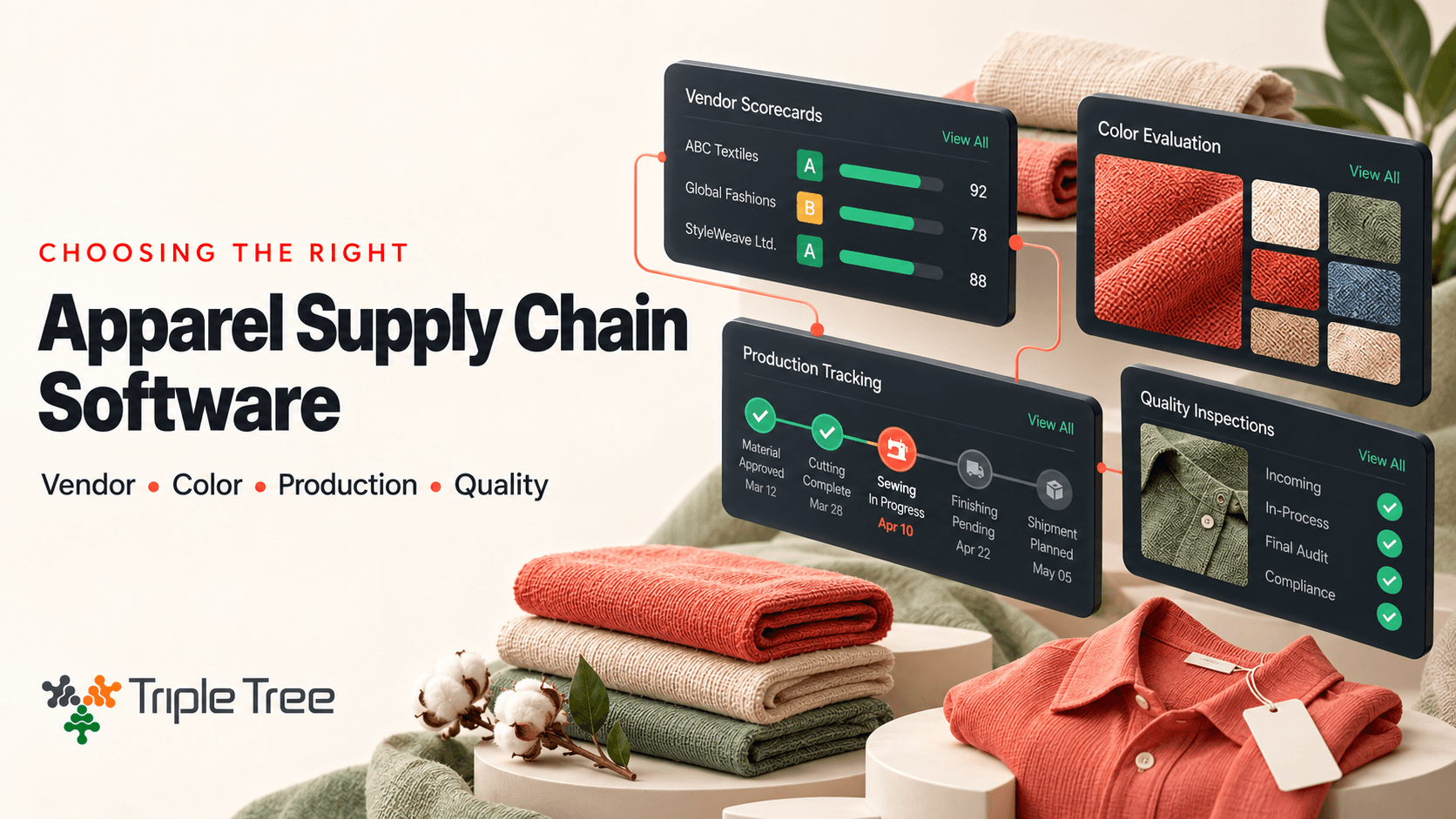
Apparel Supply Chain Management Software: 4 Best Solutions

Triple Tree Solutions
Oct 15, 2026

COLOR
The Complete Guide to Color Management in Textile & Apparel
Triple Tree Solutions
Oct 6, 2026
COLOR
The Complete Guide to Color Management in Textile & Apparel
Triple Tree Solutions
Oct 6, 2026