Beyond the Spectrophotometer: One Color Standard for Every Material in Your Collection
The spectrophotometer is still the baseline for solid color. But heathers, prints, washes, trims and the fabric arriving at the cut and sew all need a way to be held against the same standard. Here is how spectral measurement, image-based evaluation and field screening work together, and how the color team stays in control.

Triple Tree Solutions
Published
October 12, 2026
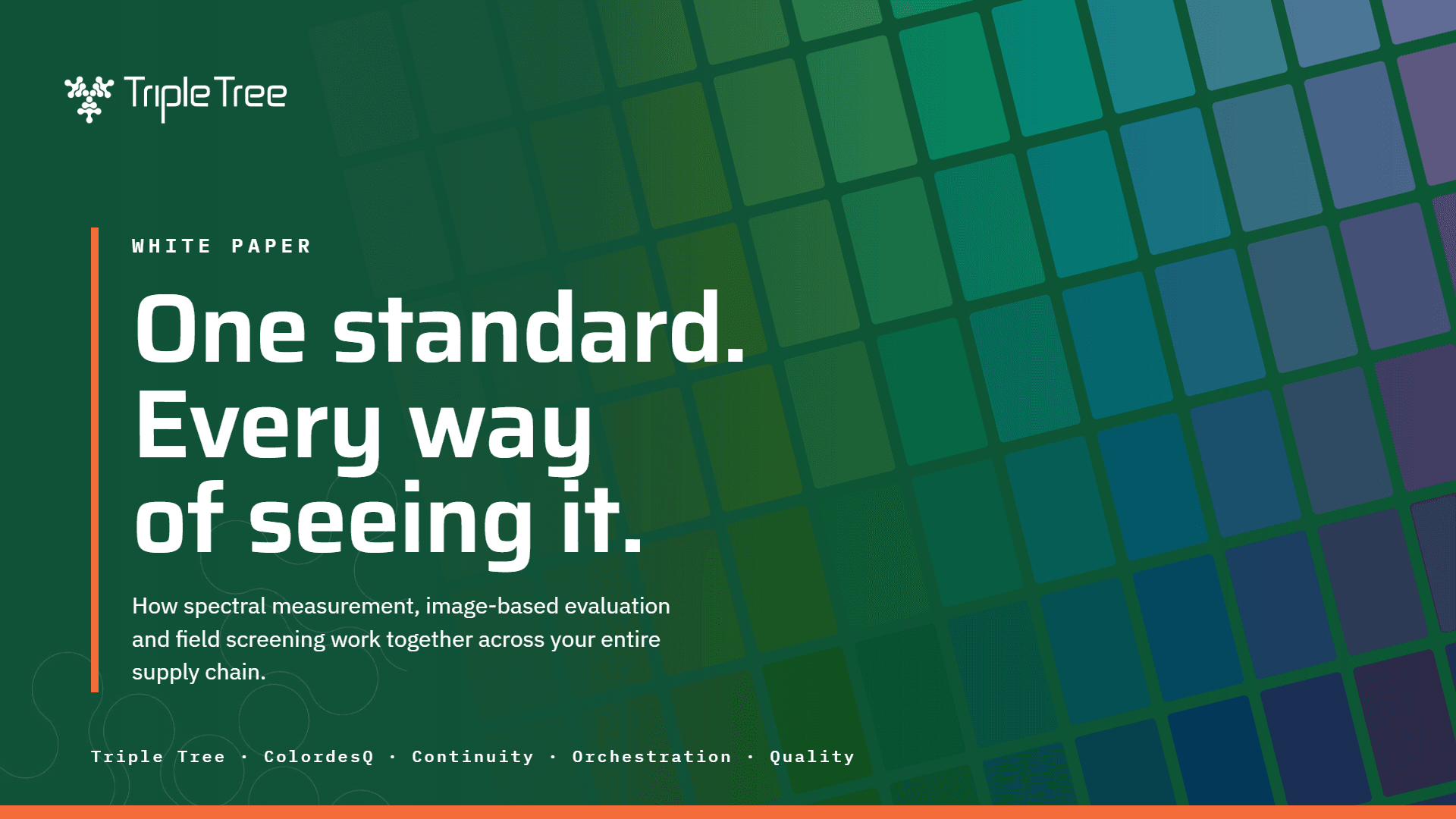
The spectrophotometer earned its place at the center of color management. It is precise, repeatable and trusted by everyone from the dye house to the brand's color lab. For solid color, nothing does the job better.
But a collection is not made of solids alone. A single assortment can carry heathers, stripes, all-over prints, washed denim, embroidery, a multicolor sweater, a satin trim, a woven label and a printed hangtag. Every one of them has to read as the same brand on the same shelf, and many of them cannot be placed under an aperture and measured meaningfully.
This article explains how spectral measurement, image-based evaluation and field screening work together in ColordesQ and QUONDA, and why the color team keeps full control at every step.
Five things to take away:
- The spectrophotometer is the baseline. It is the shared language of mills, dye houses, color providers and brands for solid color.
- Not every color can be read by one. Heathers, prints, yarn-dyes, washes, embellishments and trims sit outside what an aperture can measure.
- Not every person in the chain has one. iCheck lets cut and sew QC screen fabric against the brand standard with an iPhone and raise a flag before cutting.
- The methods are layers, not rivals. Use one, some or all of them to fit your collection, supply chain and partners.
- Authority does not move. The color team sets the standards, tolerances and decisions. Every other method adds signal, earlier and from more places.
At a Glance: Five Ways to See Color
At a Glance: Five Ways to See Color
| Method | Best for | Typically used by | Role |
|---|---|---|---|
| Spectrophotometer (e.g. Datacolor, X-Rite) | Solid colors: lab dips, bulk, solid trims and components | Colorists, color labs, mills, dye houses, color providers | Evaluation |
| Spectral imaging (e.g. SpectraVision, VeriVide) | Multicolor materials where spectral data per color matters; also solid fabrics and trims | Color labs, advanced mills, print suppliers | Evaluation |
| Calibrated scanner (ICC profile) | Flat prints, yarn-dyes, heathers, labels, packaging | Brand and supplier development teams | Evaluation |
| Calibrated camera (ICC profile, e.g. 3T Smart Table) | Textured, shiny, washed or three-dimensional items | Brand and supplier development teams | Evaluation |
| iCheck (iPhone, in QUONDA) | Fabric as it arrives at the cut and sew | Factory QC and field QC, no color lab required | Screening |
The Collection Has Outgrown the Instrument
Color management in apparel was built around a remarkable tool. The spectrophotometer is precise, repeatable and trusted by everyone from the dye house to the brand's color lab. For solid color, nothing does the job better.
But a collection is not run on just solids. A single assortment can carry heathers, stripes, all-over prints, washed denim, embroidery, a multicolor sweater, a satin trim, a woven label and a printed hangtag, and every one of them has to read as the same brand on the same shelf. Many of those materials cannot be placed under an aperture and measured meaningfully.
And the people who see the fabric last, before it becomes a garment, rarely have a spectrophotometer or the ability to communicate an issue until it is too late. The cut and sew QC and the field inspector are often the first to sense something is off, with no structured way to say so.
The result is that color work tends to live in three places at once:
- What is measured: solids, held against the standard with data
- What is judged by eye: non-solids, moving through couriered strike-offs, email threads and light-box opinions
- What is not checked at all: the gap between bulk approval and what the factory actually cuts
If color decisions live in three different places, who is holding the whole collection together?
The answer is not to replace the instrument. It is to connect everything around it, so the materials and people the spectrophotometer cannot reach are held to the same standard, in the same system, by the same color team.
The Principle: One Standard, Many Contributors
ColordesQ is built on a simple idea. The brand's standard is the reference and the single source of truth, and the color team owns it. Every method evaluates against it. What changes is how many materials, and how many people, can be held against it. Each way of seeing color answers a different question.
The Layers
| Layer | What it is | The question it answers |
|---|---|---|
| Spectral evaluation | Spectral data from a spectrophotometer. The most precise evaluation and the basis for approvals and tolerances. | How far is this color from the standard? |
| Image-based evaluation | Assessment of non-solids, visual or with RGB and spectral deltas, cycle after cycle. | How does this compare to the standard and the last submit? |
| Field screening | iCheck in the hands of the people closest to the fabric. A flag raised early and routed to the right people. | Is there something significant someone should look at now? |
Reading down the table, participation widens. Decision authority does not. A screening flag can start a conversation; it never ends one. An image comparison can inform an approval; the color team still makes it.
Spectrophotometer: The Baseline
The instrument illuminates the sample and reads how much light is reflected at each wavelength across the visible spectrum. That spectral curve is the color's fingerprint. From it, the software calculates L*a*b* coordinates under any light source, the color difference (ΔE) to the standard using formulas such as CMC or CIEDE2000, and the risk of metamerism when the light changes.
It is the baseline because it is repeatable, device-independent and shared. Standards from color libraries are defined spectrally, mills formulate recipes from it, and brand and mill read the same numbers.
In ColordesQ, spectral evaluation comes with:
- Standards from brand and color-provider libraries such as Coloro, Pantone and Archroma
- Configurable tolerances and preferred quadrants, set by the color team
- Auto-approvals where the team chooses to allow them
- A Drift Indicator showing which way a color missed
- Cross-comparison by supplier, material and season
Use it for: solid lab dips, bulk approvals, solid trims and components, and any must-match color within a non-solid that it can read. If a spectrophotometer can read it, spectral evaluation stays the baseline.
Already measuring solids?
Bring your non-solids into the same system. ColordesQ holds prints, heathers, washes and trims against the same standard as your lab dips, at the depth your suppliers can support.
Image-Based Evaluation: Non-Solids in the Same System
A spectrophotometer averages everything inside its aperture. Point it at a heather or a print and the colors blend into one reading that describes none of them. Texture, sheen and pattern scale make it worse. Image-based evaluation lets ColordesQ hold these materials against the standard instead of leaving them to the light box.
It applies to screen prints and all-over prints, embellishments and embroidery, multicolor wovens and knits, heathers, denim and washed articles, shiny materials and lingerie components, and trims, labels and packaging.
Three Ways to Capture
Spectral imaging. Instruments such as Datacolor SpectraVision capture spectral data across an image, so each pixel corresponds to a spectral value, though only over a small area.
Calibrated scanner. A scanner set up with an ICC profile, so its readings mean the same thing every time. Matched setups at the brand and each supplier mean an image scanned in Asia reads the same as one scanned at headquarters. Best for flat materials, including washed fabrics.
Calibrated camera. A controlled lighting and capture setup for what a scanner cannot handle well: entire garments, or textured, semi-transparent and three-dimensional items.
Four Depths of Evaluation
Each brand picks the depth that fits. Whatever the depth, standard, submit and bulk sit side by side, cycle after cycle, in the same workflows and timeline as the brand's solids.
- Visual only: standard, developments and bulk side by side or on a slider. A simple start that replaces couriers and email threads.
- Visual + RGB data: define areas on each color in the image and get a delta for each one.
- Visual + spectral data: must-match colors that can be read spectrally keep spectral evaluation as their baseline.
- Visual + RGB and spectral: both combined, for the fullest set of deltas on complex materials.
iCheck: Screening by the People Closest to the Fabric
iCheck is a color check inside the QUONDA mobile app. When fabric lands at the cut and sew, the QC or factory compares it to the brand's standard using an iPhone under controlled shooting conditions. If the shade has moved significantly, it is flagged while the goods can still be returned, reprocessed or reallocated, and the right brand stakeholders are alerted immediately.
How it works:
- Capture and compare: standard against fabric, or roll against roll, in one guided frame, in under a minute
- A number, not an opinion: ΔE and the direction of the miss in hue, lightness and chroma
- A Screen Result: Flag or No Flag, against an alert level set deliberately high so only significant misses are raised
- One record: traced to the PO, style, fabric, lot and inspector, with brand QA, sourcing and the color team alerted in real time
Why Before Cutting Matters
While it is still fabric, every option is open: return the lot at the mill's cost, re-dye or reprocess, sort by roll, or reallocate to another order. Once it is cut, color is the defect with no rework path. The options become discounts, chargebacks and air freight to replace what was scrapped.
Fabric is still an option. A cut panel is a decision.
What iCheck Is, and Is Not
iCheck is a field screening check anyone in the supply chain can run to confirm the goods in front of them are not a significant departure from what the brand approved. It screens for significant deviation, not laboratory nuance.
It is not a spectrophotometer, not a lab measurement and not ColordesQ. Nothing is rejected on an iCheck reading. A flag starts the conversation, and technical resolution happens with your color team and the proper tools.
That is also why iCheck uses an alert level, not a tolerance. Tolerance is a contractual term that belongs to your color team and your lab. iCheck's threshold claims no authority over approval, only a reason to look.
Catch shade shifts while the fabric can still go back.
See iCheck in ActionMatching the Method to the Material
An indicative guide. The right setup depends on your materials and suppliers, and is configured with you.
Matching the Method to the Material
| Material | Spectrophotometer | Spectral imaging | Scanner (ICC) | Camera (ICC) |
|---|---|---|---|---|
| Solid fabrics, knit and woven | Baseline | Supporting | - | - |
| Solid trims, threads and components | Baseline | Supporting | - | - |
| Heathers and melanges | - | Primary | Primary | - |
| Yarn-dyes: stripes, plaids, multicolor knits | Must-match colors | Primary | Primary | |
| Screen prints and all-over prints | Must-match colors | Primary | Primary | - |
| Embellishments and embroidery | - | Supporting | Supporting | Primary |
| Denim and washed articles | - | - | Primary | Supporting |
| Shiny and specialty materials | Must-match colors | - | Primary | Primary |
| Labels and packaging | Must-match colors | - | Primary | Primary |
At the cut and sew, fabric arriving for production can be screened with iCheck before the first cut, whatever method approved it upstream.
Who Does What
Who Does What
| Role | Primarily works with | What changes for them |
|---|---|---|
| Color team and colorists | Spectrophotometer and ColordesQ approvals; reviews image evaluations and flags | Owns standards, tolerances and decisions, and now sees the whole assortment and every mill's performance in one place |
| Mills and dye houses | Spectrophotometer | Knows where a dip stands before submitting. Fewer rejected cycles, cleaner production planning |
| Print, yarn-dye and knit suppliers | Scanner, camera or spectral imaging | Sees the standard, the last submit and what moved before resubmitting. Fewer strike-off rounds |
| Product and sourcing | ColordesQ views and status | Strike-offs and multicolor fabrics approved virtually, at the speed of the rest of the calendar |
| Cut and sew QC, field QC | iCheck on an iPhone | Can flag a fabric problem they did not create, before it becomes the cutting room's problem |
How the Layers Connect
Every path leads back to the same standard and the same people.
- Standard set: the color team defines the standard and tolerance in ColordesQ.
- Development: solids are measured spectrally; non-solids are evaluated by image at the chosen depth.
- Bulk approval: production is held against the same standard, by the same team.
- Fabric receipt: cut and sew QC screens with iCheck before cutting.
- Resolution: any flag routes back to the color team and the proper tools.
Your Depth, Your Call
There is no single right way to handle non-solids or field screening. Some brands start simple and add layers as suppliers come on board; others go deep from day one. Three common shapes:
Your Depth, Your Call
| Program Shape | Start Simple | Structured | Full Orchestration |
|---|---|---|---|
| Goal | A first step out of the light box | Consistent data across key suppliers | The whole collection, every layer |
| Solids | Spectral | Spectral | Spectral, plus must-match colors in non-solids |
| Non-solids | Visual-only comparison | Matched calibrated scanners at key print and yarn-dye suppliers, with Lab deltas | Spectral- and RGB-based imaging on complex materials; camera for specialty materials |
| Field Screening | iCheck at a handful of key cut and sew partners | iCheck across all cut and sew partners | iCheck at every fabric receipt |
The methods can run alone, together, or one program at a time. The deciding factors are the brand's workflows, its supply chain and what its partners are equipped to do.
A Note to Color Teams: More People Can Raise a Hand. The Same People Make the Call.
What does not change
- The spectrophotometer remains the baseline for everything it can read
- Standards, tolerances and approvals stay with you
- Realistic image information can supplement spectral values, and vice versa
- Nothing is rejected on an iCheck reading
- Exceptions are deliberate, recorded and owned
What does change
- Solids and non-solids, across the whole assortment, in one place
- Mill performance visible by supplier, material and season
- Information flows to every mill in a structured way, not by email
- Significant problems surface before cutting, from people who never had a way to tell you
- Time back for the work that genuinely needs your eye
ColordesQ does not ask the color team to give up control. It extends their reach to every material, every mill and every stage, with automation where it helps and judgment where it matters.
What It Adds Up To
You are not matching one color; you are conducting hundreds. Mills, substrates, trims and components all have to agree. Connecting every way of seeing color on one standard turns isolated instruments into an orchestra.
- Control: one standard, owned by the color team, applied to every material and every partner
- Continuity: solids, non-solids, trims and components land in harmony
- Speed: fewer development cycles and virtual approvals that keep pace with the calendar
- Cost: fewer couriered swatches and strike-offs; problems caught while fabric can still be returned, reprocessed or reallocated
- Transparency: brand and suppliers work from the same facts, so conversations start from data rather than opinion
- A lighter footprint: fewer physical samples in transit, fewer re-dyes and less cut fabric scrapped
See it on your colors.
Bring one solid, one non-solid and one delivery where the shade was questioned. In 30 minutes we'll show you how each runs through ColordesQ and iCheck, and exactly where your color team stays in control.
Key Terms
ΔE (delta E): a single number expressing how far one color is from another. Smaller is closer.
Spectral data: how much light a material reflects at each wavelength. The most complete description of a color.
Metamerism: when two colors match under one light and not under another.
ICC profile: a file that characterizes a scanner or camera so its color readings are consistent and comparable.
Tolerance: the approval limit set by the color team. Contractual and decision-grade.
Alert level: iCheck's screening threshold, set high to raise significant misses only. Not an approval limit.
Get more insights like this delivered straight to your inbox!
TRENDING NOW
Community Favorites
PRODUCTION
The Complete Guide to Apparel Production Tracking & PO Management
Triple Tree Solutions
Jul 29, 2026

Industry Events
What to Expect at PI Apparel’s Fashion Technology Show NYC 2026
Triple Tree Solutions
Jul 15, 2026

QUALITY
The Complete Guide to Textile & Apparel Quality Inspection
Triple Tree Solutions
Jul 2, 2026
QUALITY
The Complete Guide to Textile & Apparel Quality Inspection
Triple Tree Solutions
Jul 2, 2026